Musical Scale and Key Patterns
From “The Pattern of a Key¨ in Music Theory for Electronic Music Producers
To find the note in any key, we always start with the root. After we have the root, we can apply a pattern made of half-steps and whole steps. This pattern is simply called the major scale. Once we’ve figured out the major scale, we will know all the notes in they[sic] key. The pattern is: W W H W W W H In this pattern, ‘W’ refers to Whole Step and ‘H’ refers to Half-Step.
A musical scale, then, can also be defined more accurately as, not just a sequence of (mechanical) keys or their pitches in order as in 20240903174948-Being_“In_Key”, but a pattern of intervals used for selection of (mechanical) keys and their pitches to comprise a key (qua “in the key of¨). These intervals are the measures half-step and whole step, as explained in 20240831183733-Semitones and 20240901015508-Whole_Tones.
Thus, the root key or root pitch “anchors¨ the scale by acting as the starting key/pitch of the pattern of selection the scale provides.
Reference image for the Major scale with C (natural) as root:
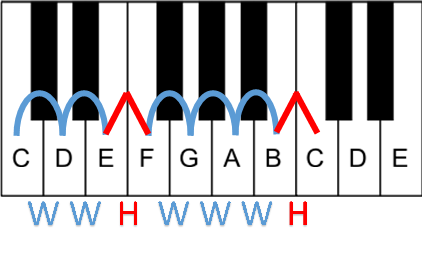
Hence, we get the key of C (Major) using the Major scale on the root C.
flowchart LR
A["Root pitch"] -->|Application of scale| C["Produced key"]
Note
“W¨ stands for “Whole Tone¨ or “Whole Step,¨ while “H¨ stands for “Semitone¨ or “Half-Step.¨
whole-step whole_step half-step root_key root_pitch musical_scale major_scale music music_theory
bibliography
- “The Pattern of a Key.” In Music Theory for Electronic Music Producers: The Producer’s Guide to Harmony, Chord Progressions, and Song Structure in the MIDI Grid., 1st ed., 54. Minneapolis, MN: Slam Academy, 2018.