Interval of a 2nd
From “The 2nd¨ in Music Theory for Electronic Music Producers
[…] the 2nd can be major or minor. Its inversion […] [t]he 7th is a very distinctive sound, so it is sometimes hard to use a 2nd for anything without it sounding like an inverted 7th.
The interval of a 2nd is the space, move or span of an inclusive count of 2 (mechanical) keys or their corresponding pitches from a musical key of a musical scale up or to the right of a standard Western classical piano keyboard or piano roll editor. In sum, it is an inclusive distance of 2 diatonic (mechanical) keys or their corresponding pitches. The half-step distance in chromatic keys may vary. The below exemplifies a 2nd with a major quality starting from C in the key of C Major scale (refer to 20240904103821-Musical_Scale_and_Key_Patterns & 20240903174948-Being_“In_Key”), which chromatically has 2 half-steps (refer to 20240831190951-Musical_Alphabet & 20240831200842-Musical_Accidentals).
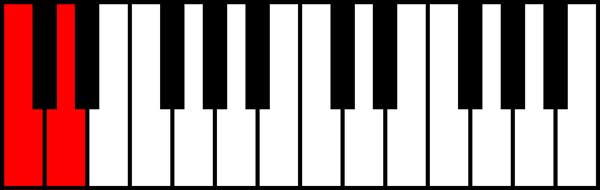
A (diatonic) minor interval of a 2nd will likely have a different amount of chromatic half-steps.
Distinguishing Major v. Minor Intervals
For distinguishing major and minor intervals, see Perfect and “Imperfect¨ Inversions.
As mentioned above, it is hard to use the 2nd without it reminding us of its relation to the sound of an interval of a 7th, as the 2nd is an inversion of the interval of a 7th (refer to 20241007141701-Interval_Inversions).
semitone key pitch musical_key musical_scale major_scale C_major_scale major_interval minor_interval minor_second major_second minor_2nd_interval major_2nd_interval music music_theory
bibliography
- “The 2nd.” In Music Theory for Electronic Music Producers: The Producer’s Guide to Harmony, Chord Progressions, and Song Structure in the MIDI Grid., 1st ed., 96. Minneapolis, MN: Slam Academy, 2018.