Musical Accidentals
From “Black and White Keys¨ in Music Theory for Electronic Producers
[…] black keys are named as relative to their nearest white note. A black key will always have a modifier that means “a semitone higher than” or “a semitone lower than.” […] What is the name of the black key just above and to the right of the A? […] Conveniently, we have a symbol that we can substitute for “a semitone higher.” The symbol is called A-Sharp, or ♯. So that pitch would correctly be called A♯, pronounced “A-Sharp.¨
Notes as Keys
Provisionally, just as was done in 20240831183733-Semitones, we will take “notes¨–as used to discuss the main sound-toggling parts of a piano’s keyboard–to mean “keys,¨ as “keys¨ is conventionally what the main sound-toggling parts of a piano keyboard are called. Since this is building up to a notation system, however, I will continue to specify these keys to be properly-tuned, i.e. set to the correct relative auditory frequencies.
Link to original
Perhaps this answers one of our questions in 20240831190951-Musical_Alphabet. Black keys are labeled relative to white keys using the musical alphabet. They do not have their own letter label, but “borrow¨ a letter label from their (white) neighbor. Then, a symbol which means that the given (black) key is a semitone higher is appended to this “borrowed¨ letter label for our (black) key: “♯.¨ Equivalently:
From “Flats, Sharps, and Naturals¨ by Music Theory for Electronic Producers
We could call the black key just to the left of the A an “A, a semitone lower.¨ For that, we would use the “flat¨, meaning a semitone lower. So we would pronounce that note as A flat, or A♭.
Thus, the symbol to be appended instead, indicating that the key is a semitone lower than the associated key of its letter label, is “♭.¨
Phrased differently, any single black key can thus be labeled by the letter of the white key a semitone lower or higher than it, wherein in the latter case the letter is conjoined with “♯¨ and in the former case the letter is conjoined with “♭.¨ The white keys are said to be “naturals¨ (Allen 2018, 24):
Quote
We sometimes call the white notes ‘Natural´: meaning they have no sharp or flat on them.
For reference:
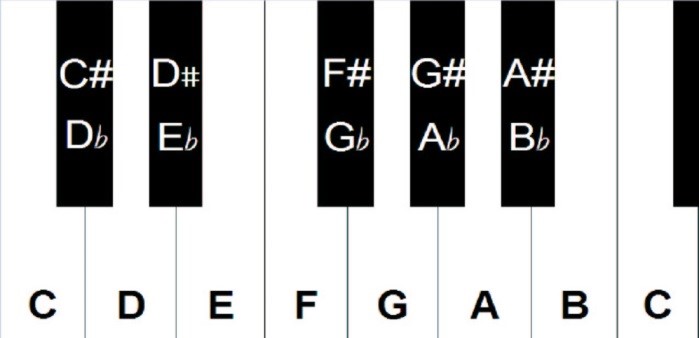
The fact that black keys can be either treated as sharps or flats depending on what (white) key they borrow their letter label from, neither being right nor wrong but more or less useful, makes them enharmonic, i.e. different names or labels for the same relative auditory frequency or properly tuned key (Allen 2018, 25).
Note
Not all white keys have accompanying sharps or flats, which means that a semitone down/left or up/right is not always a sharp or flat. Sometimes, going up or down a semitone leads to another natural.
That being said, if a key can be described as sharp or flat, then it is always a semitone lower/leftware or higher/rightward than a given key. Sharps and flats are just a way to include the black keys, with the “natural¨ being a conceptual by-product or side-effect.
accidentals naturals flats sharps flat_accidental sharp_accidental #♯ #♭ black_keys white_keys music music_theory
bibliography
- “Black and White Keys.” In Music Theory for Electronic Music Producers: The Producer’s Guide to Harmony, Chord Progressions, and Song Structure in the MIDI Grid., 1st ed., 23. Minneapolis, MN: Slam Academy, 2018.
- “Flats, Sharps, and Naturals.” In Music Theory for Electronic Music Producers: The Producer’s Guide to Harmony, Chord Progressions, and Song Structure in the MIDI Grid., 1st ed. Minneapolis, MN: Slam Academy, 2018.
- “Enharmonic Notes.” In Music Theory for Electronic Music Producers: The Producer’s Guide to Harmony, Chord Progressions, and Song Structure in the MIDI Grid., 1st ed., 23. Minneapolis, MN: Slam Academy, 2018.