Musical Notes
Musical notes can of course be conveyed through the musical alphabet together with symbols for accidentals, but they can also be symbols of duration marked onto staves with clefs determinant, via position across the stave lines, of their pitch meaning.
Conventionally, such a symbol tends to be comprised of a few parts (Gould 2011, 9-10 & 13):
- A notehead, an either filled or non-filled diagonally-slanted oval shape, upright non-slanted triangle shape, non-slanted diamond shape, or a cross mark that is placed onto a stave line or stave space (Gould 2011, 9-13)
- A stem, a line protruding from either the right or left of the notehead and moving either up or down from it (Gould 2011, 12-13)
Noteheads
There are two communicative aspects to a notehead: its shape / form and its having or lacking a fill.
Oval Notehead
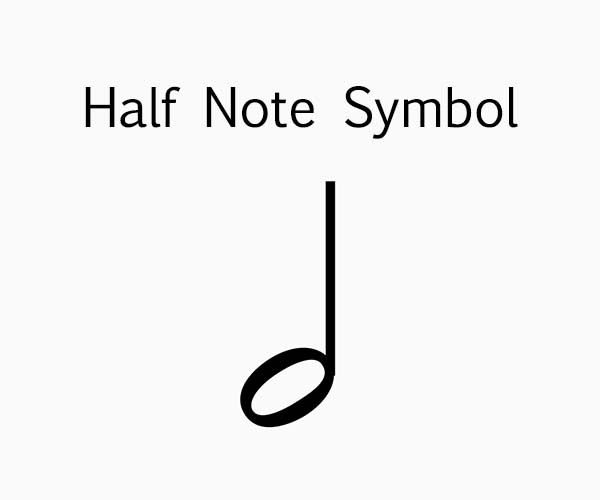
A notehead lacking a fill is known as a white notehead, and a notehead that has a fill is known as a black notehead (Gould 2011, 9). A slanted white notehead with a stem that has nothing attached to it is a half note or minim (Gould 2011, 10).
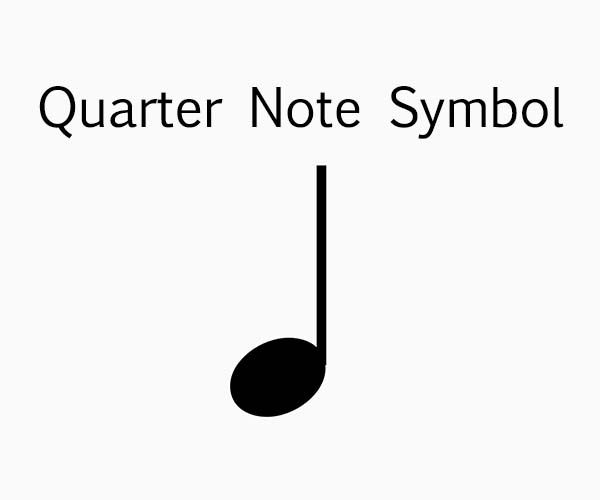
Slanted black notehead with a stem is a quarter note or crotchet
A slanted black notehead with a stem comprises a quarter note or crotchet, which means that it is half of the half note in duration value, while the half note is double in duration for the crotchet or quarter note.
A white notehead with no stem, that is also a bit larger and has less slant, is a whole note or semibreve (Ibid). A white notehead lacking a stem while being flanked at its sides by double-lines is a breve or a double (whole) note (Ibid).

Diamond-Shaped Notehead
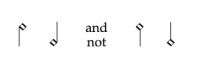
A diamond-shaped notehead–having concave sides and more thickness on its diagonal lines–that can take a stem on its left or right corners can be used to notate non-piano harmonics, silently depressed piano key sounds, singing via wind instrument, sounds requiring unconventional technique on a wind instrument, indicate multiphonics, unvoiced vocals, and optional falsetto (Gould 2011, 11). For string harmonics, diamond-shaped noteheads are always unfilled for bowed string and woodwind instruments while they can sometimes be filled for plucked/strummed string instruments (Ibid).
Crossed Notehead
A crossed notehead is comprised of two unshaded intersecting diagonal lines that can take a stem at its nearest edges (Gould 2011, 12). It is often used for notating percussive sounds or sounds with indefinite pitch, distinguishing instruments or their beating spots in percussion, distinguishing spoken text, indicating vocal style between speaking and singing, and notating optionally approximate pitch (Ibid).
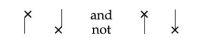
For purposes of distinguishing minims / half-notes, semibreves / whole notes, and breves / double notes, crossed noteheads may be surrounded by a thin, light circle or otherwise be replaced by diamond-shaped noteheads instead (Ibid).
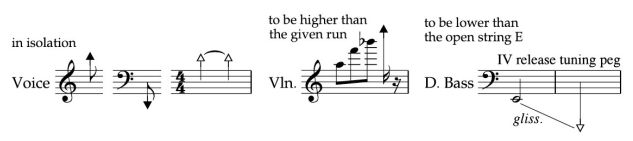
Triangular Notehead
Finally, a triangular notehead is comprised of a filled or unfilled triangle that can take a stem at the center of its base (Gould 2011, 12-13). A whole note or semibreve using a triangular notehead should involve two tied minims or half-notes for clarity (Ibid). A triangular notehead may be used to indicate an unspecified highest or lowest possible pitch and is always placed beyond or outside of the stave (Ibid).
Stem
A stem–a line that is attached to the right or left of a notehead and protrudes downwards or upwards–on a stave or in a system follows particular rules.
Stem Direction
If the notehead a stem is to be attached to is above the middle line of the standard stave, then the stem runs downward from the notehead and is called a down-stem; meanwhile, if the notehead a stem is to be attached to is below the middle line of the standard stave, then the stem runs upward from the notehead and is called an up-stem (Gould 2011, 13).

If the notehead lands right on the middle of the stave, it by default takes a down-stem but otherwise either takes a stem adopting the direction of surrounding stems or takes a stem adopting the direction of stems within the same beat or half-bar (Gould 2011, 13-14).
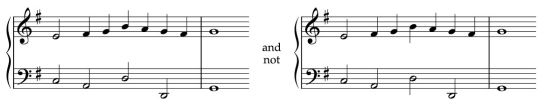
Conventionally, stems are stave spaces in length (Gould 2011, 14). When a linked notehead is placed more than one ledger line high and its stem faces towards the stave, the stem extends further than 3.5 stave spaces if need be towards the middle stave line (Ibid). Stems facing away from the stave is progressively shortened by stave spaces the further away the stems fall outside the stave (Ibid).
Tails
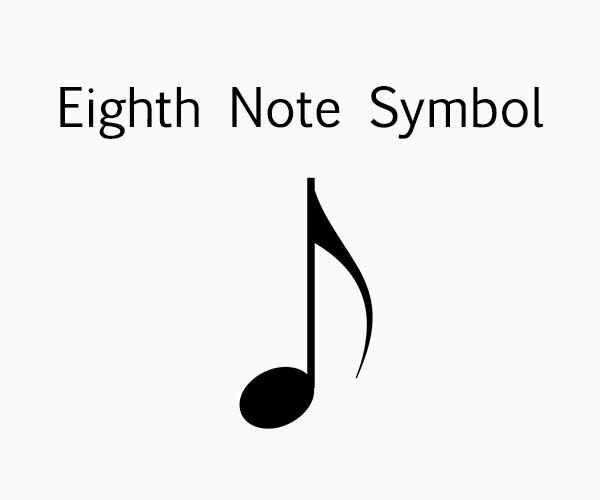
A tail is shaped like a flag at low mast when on an up-stem–it is a curved, diagonal line coming from the open end of a stem, going towards the opposite direction of the stem itself relative to the given notehead (Gould 2011, 15).
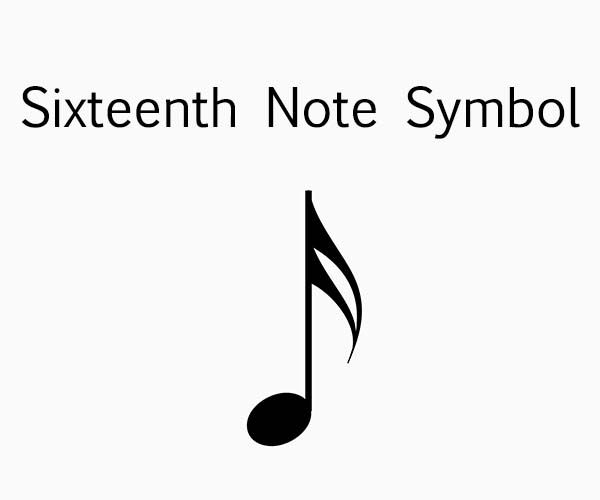
A quaver or eighth note has a black notehead and a stem with a single tail attached to it (Ibid). A semiquaver or sixteenth note also has a black notehead and a stem, but with the stem having two tails attached to it (Ibid). The stem may be extended the more tails are added further from the notehead (Gould 2011, 16).
Semantic Pattern of Tails
The semantic pattern seems to be, for tails, that each tail is a half subdivision of the last, or an increment by a factor of of the last tail on the stem.
Beams
A beam is a thick, black rectangle used in place of tails to group notes together, typically to reflect the rhythmic pattern they contribute to (Gould 2011, 17). The thickness of a beam is typically stave spaces tall (at its shortest side, as the rectangle is laid on its longer side), while the gap between beams is stave spaces tall (Ibid). Preferably, a “beam must be attached to the top or bottom of a stave-line or else be centred on the line” (Ibid).
When using a fractional beam, which is a beam that only protrudes partway from a stem without attaching to another note’s stem, it should be to long (horizontally).
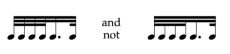
Further, beams can also be angled, making them angled beams, provided they follow the previous rules for straight beams for each end of the beam connecting given notes together and provided the diagonal “reach” is only one to two stave spaces in difference (Gould 2011, 19-20).
musical_alphabet white_notehead black_notehead double_note double_whole_note oval_notehead diamond-shaped_notehead half_note whole_note crossed_notehead mechanical_key down-stem up-stem rhythm tail tails eighth_note crotchet_note sixteenth_note quaver_note semiquaver_note minim_note breve_note semibreve_note
bibliography
- “Ground Rules.” In Behind Bars: The Definitive Guide to Music Notation, 3–45. London, UK: Faber Music, 2011.