Staves
From “Ground Rules¨ in Behind Bars
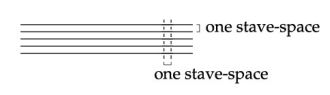
The size of every notational symbol is measured in proportion to the stave size. A stave-space is the distance between two stave-lines and is used as a measurement for notational symbols and spacing.
Staves can have any number of lines, but the most common conventional ones are the five-line and single-line staves. For the stave, lines run horizontally, and have equal vertical spacing among them.
Single-line staves are used (Gould 2011, 5):
- To notate instruments of indefinite pitch
- To notate sounds of indefinite pitch (e.g., percussive sounds) produced on pitched instruments
- To notate vocal sounds of non-specific pitch
- To notate a cue line of rhythm
- As an option to show approximate pitch
Staves and the musical alphabet
Stave-spaces and stave-lines together vertically represent some segment of the looping sequence of the musical alphabet.
five-line_staves five-line_stave single-line_stave single-line_staff stave_lines stave_line stave-line stave_space music_theory musical_notation stave staves staff loop musical_notation musical_note musical_notes music_theory
bibliography
- “Ground Rules.” In Behind Bars: The Definitive Guide to Music Notation, 3–45. London, UK: Faber Music, 2011.