Time Signature
From bib. source
That is, a time signature conveys the overall rhythmic structure that forms the basis of the melodic content of the musical track or passage for subsequent measures or bars, communicating the meter type, beat division, and beat type either directly or by implication (Almén 2018, 28).
Simple Time Signature
The way the time signature is written in the usual case is as two numbers aligned vertically (Ibid):
From bib. source
The top number indicates the number of beats in the measure. The bottom number indicates the beat note (2 = 𝅗𝅥, 4 = 𝅘𝅥, and so on).
The usual case being when a time signature has a simple beat, allowing it to be characterize as a simple time signature.
Time signature may contain fractional values but is not itself meant to be a fraction
The time signature should not be treated as if it is a fraction, because it is not itself a fraction.
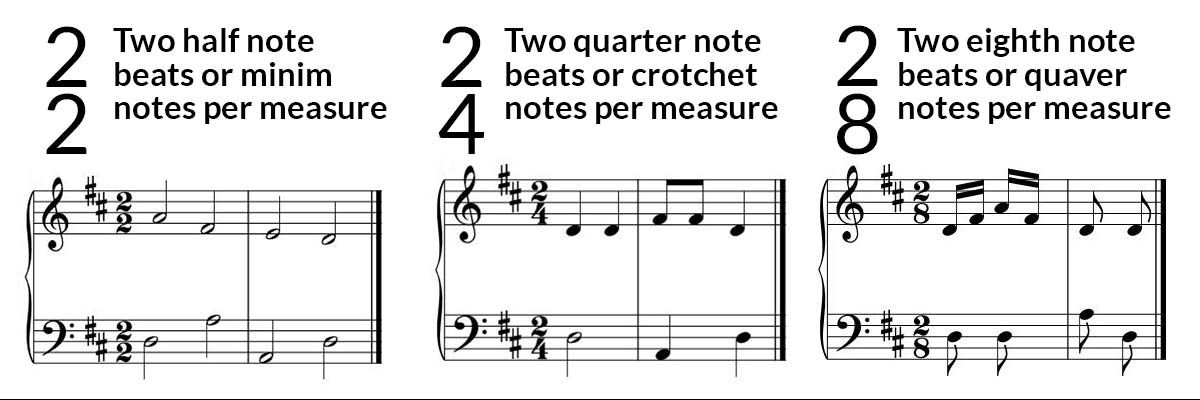
Time signature placement
On the staff, a time signature fills its maximum height and is marked after the clef and key signature.
Compound Time Signature
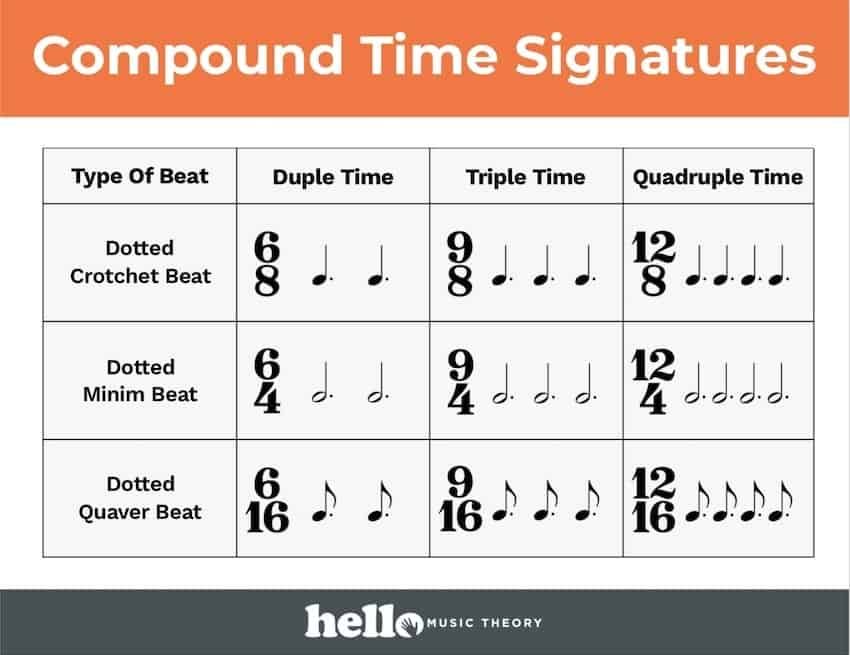
There are many ways one could express the division of the beat into three equal parts in a time signature–consequently, there are many ways one could express a compound time signature (Almén 2018, 29). For example, the bottom number of the time signature could be written as or to represent, for example, a beat that can be broken down into 3 eighth notes (Ibid). But this bottom number could also be written as to show that one is dealing with a quarter note or crotchet extended further by a half of itself–or, maybe it is clearer for the bottom number to be or (Ibid).
Since a time signature, compound or simple, is supposed to inform on “the number of divisions of the beat contained in a measure and what the division duration is,” for time signatures with compound beats the conventional solution is to encode that same information by using a different operational algorithm. Often, for time signatures of compound beats “the top number […] will be 6, 9, or 12,” as (Ibid):
From bib. source
[…] two beats times three divisions equals six, three beats times three divisions equals nine, and four beats times three divisions equals twelve.
The formula for the top number of a compound time signature is thus as follows, wherein is the number of beats, is the number of (sub-)divisions per beat, and is the top number of our compound time signature:
In addition (Ibid):
From bib. source
As a result, you must divide the top number of a compound time signature by three to find out how many beats will occur in each measure.
This means that the previous formula for the top number of a compound time signature can be reworked to derive the number of beats in the measure from that time signature:
We can generally assume , i.e. that the number of beat subdivisions is , in the simplified case for the compound beat of our time signature. Nevertheless, as soon as this is calculated, we then assume that each beat is a duration dictated by the bottom of the compound time signature, except extended by a duration that is half of itself. Hence that each notated beat duration has a dot on its right (in particular, on the right of its notehead).
The reason for implicitly encoding additional information in the top number of a time signature indicative of compound beat composition, is that the bottom number then no longer needs to convey a note value that is half a beat duration longer than otherwise.
Alleged simple time signature equivalents to compound time signatures
One can conceive of a scenario where a simple time signature could be written in such a way that looks like a compound time signature. For example, a over time signature could very well be simple so long as it is conveying that the measure or bar has eighth notes or quavers (Ibid). Conventionally, this would not be written as a over time signature, however, but instead a over –not just to be able to tell compound time signatures apart, but because there is a real difference in how a over compound time signature would sound and how an “alleged” over (or really over ) simple time signature would sound (Almén 2018, 31).
time_signature music_theory musical_bar musical_measure musical_track musical_passage melody musical_notation division_operator division_operators divisions_of_the_beat beat_divisions beat_subdivisions meter musical_meter staff stave staves rhythm dotted_note code encoding decoding mathematics mathematical_operator mathematical_operators multiplication multiplication_operator multiplication_operators duration subdivision eighth_note quarter_note quaver_note crotchet_note
bibliography
- Kostka, Stefan, Dorothy Payne, and Byron Almén. Tonal Harmony: With an Introduction to Post-Tonal Music. 8th ed. New York: McGrawHill Education, 2018.