Beat Divisions
From bib. source
Beats generally divide either into two equal parts, called simple beat, or into three equal parts, called compound beat.
Technically, a beat can be divided into many different amounts of equal parts, but all subdivisions can be reduced to fractional values (denominators) of or for the given beat. Put another way, subdivisions of a beat can either be a multiple of or of . Either way, the former would be a simple beat and the latter would be a compound beat (Almén 2018, 27). Be mindful enough to (Ibid):
From bib. source
Be careful not to confuse beat type, which refers to how the beat divides (simple or compound), with meter type, which refers to how the measure divides (duple, triple, or quadruple).
Constraints on further division
Perhaps it is more accurate to say that the beat type tells us how the beat can be further divided within the given meter, whereas the meter tells us how the many beats are grouped in the measure.
So, meters of any type can have beats of any type (Ibid):
| beat type | duple meter | triple meter | quadruple meter |
|---|---|---|---|
| simple | simple duple time | simple triple time | simple quadruple time |
| compound | compound duple time | compound triple time | compound quadruple time |
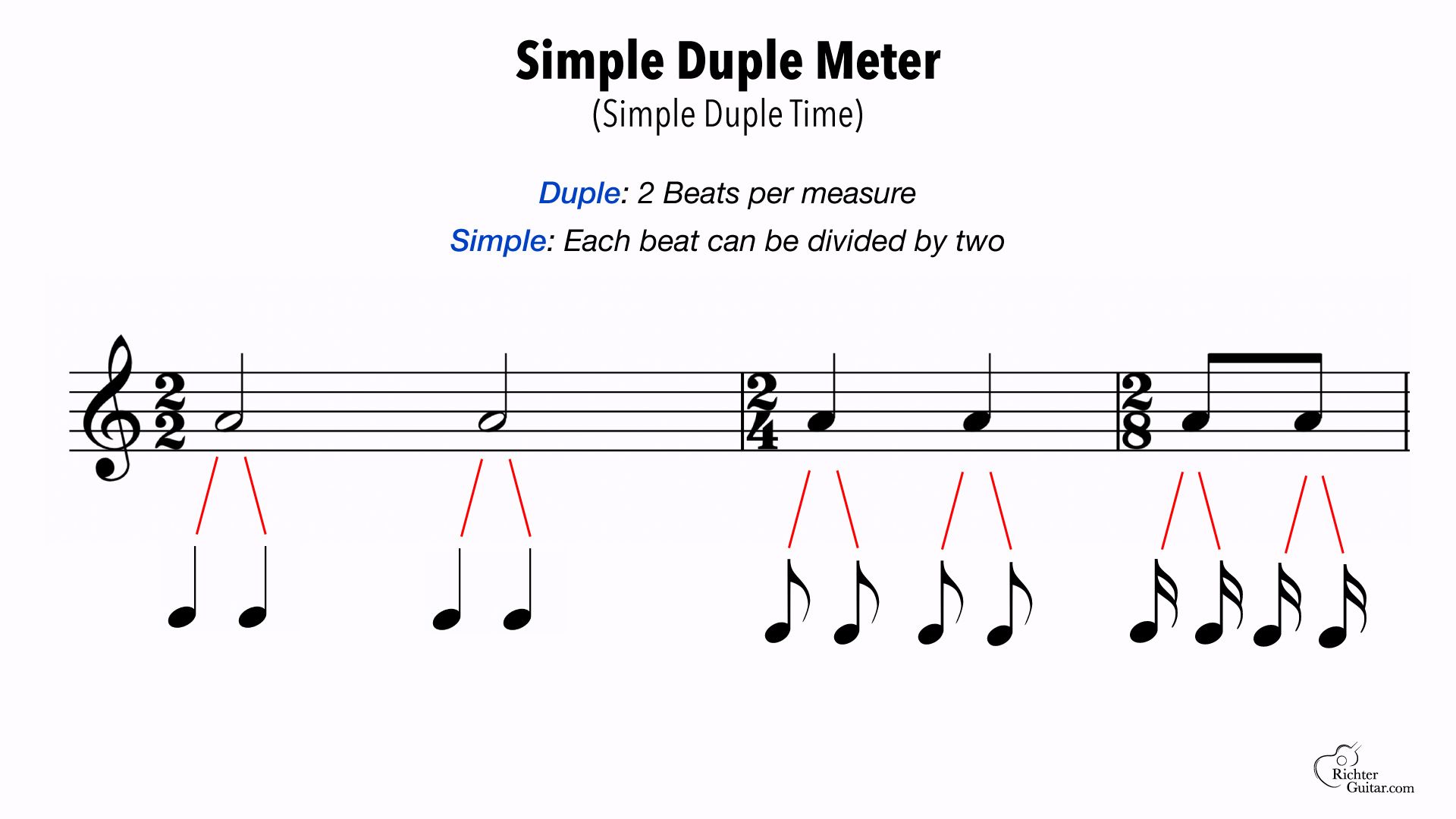
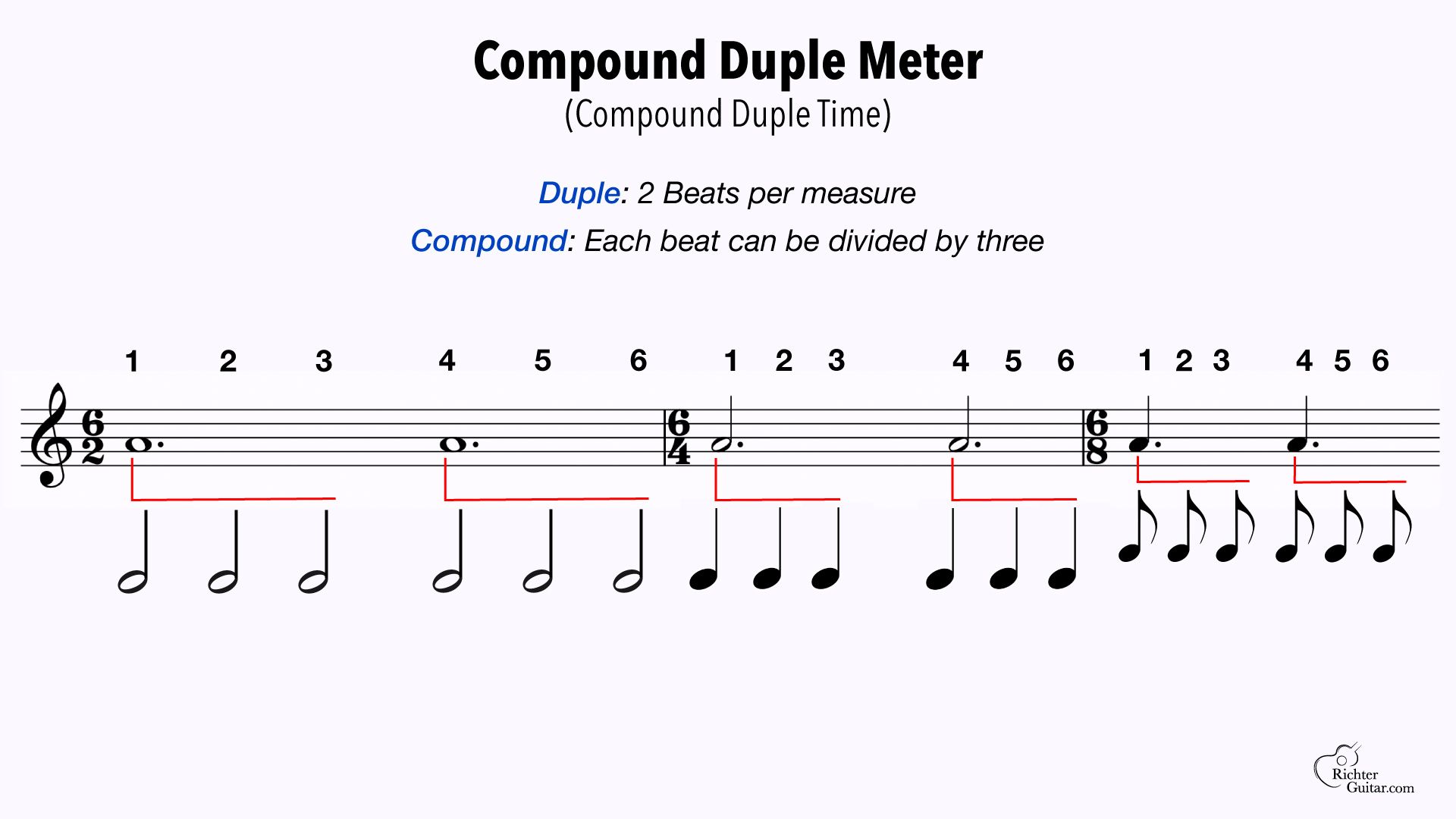
Beats and division
Conventionally, beats have their basic subdivision written in terms of the maximum subdivisions they can have, or the minimum division that can be enacted on them. This is regardless of whether they are simple or compound.
fraction music_theory division mathematics mathematical_operator mathematical_operators equality denominator reducible_fraction fraction_reduction fraction_simplification multiplication division_operator division_operators multiplication_operator multiplication_operators simple_beat compound_beat rhythm divisions_of_the_beat beat_divisions beat_subdivisions
bibliography
- Kostka, Stefan, Dorothy Payne, and Byron Almén. Tonal Harmony: With an Introduction to Post-Tonal Music. 8th ed. New York: McGrawHill Education, 2018.