Clefs
From “Ground Rules¨ in Behind Bars
There are four clefs in common use. It is important to place each on the stave so that it centres precisely on the relevant stave-line.
The 4 clefs in common use on staves are as follows (Gould 2011, 5-6):
- Treble clef, also known as G clef
- Bass clef, also known as F clef
- C clefs
- Percussion clefs
Treble Clef
This clef looks like a ladle, whose top end curves like a snake back across the ladle handle, and then winds downward and back up crossing the ladle handle twice.
This winding portion is placed “around the G line¨ (Gould 2011, 6):
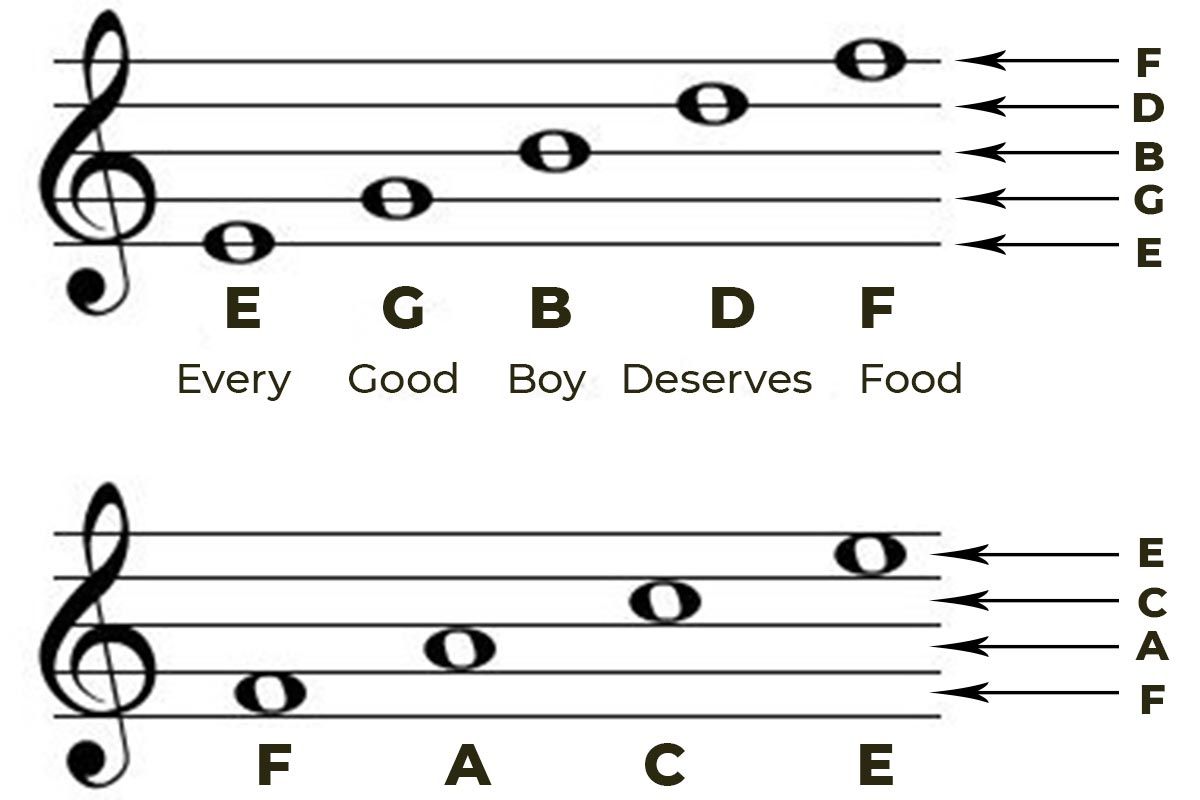
Which is to say, that the winding portion of the treble clef determines the note value of the horizontal stave-line it is on to be G natural (refer to musical accidentals). This is why it is also called the G clef (Ibid).
Open: Pasted image 20250425173947.png
Bass Clef
This clef looks like a distorted, curved “C¨ flipped horizontally, then followed by a colon. Or, a sideways unhappy face with the frown leftward.
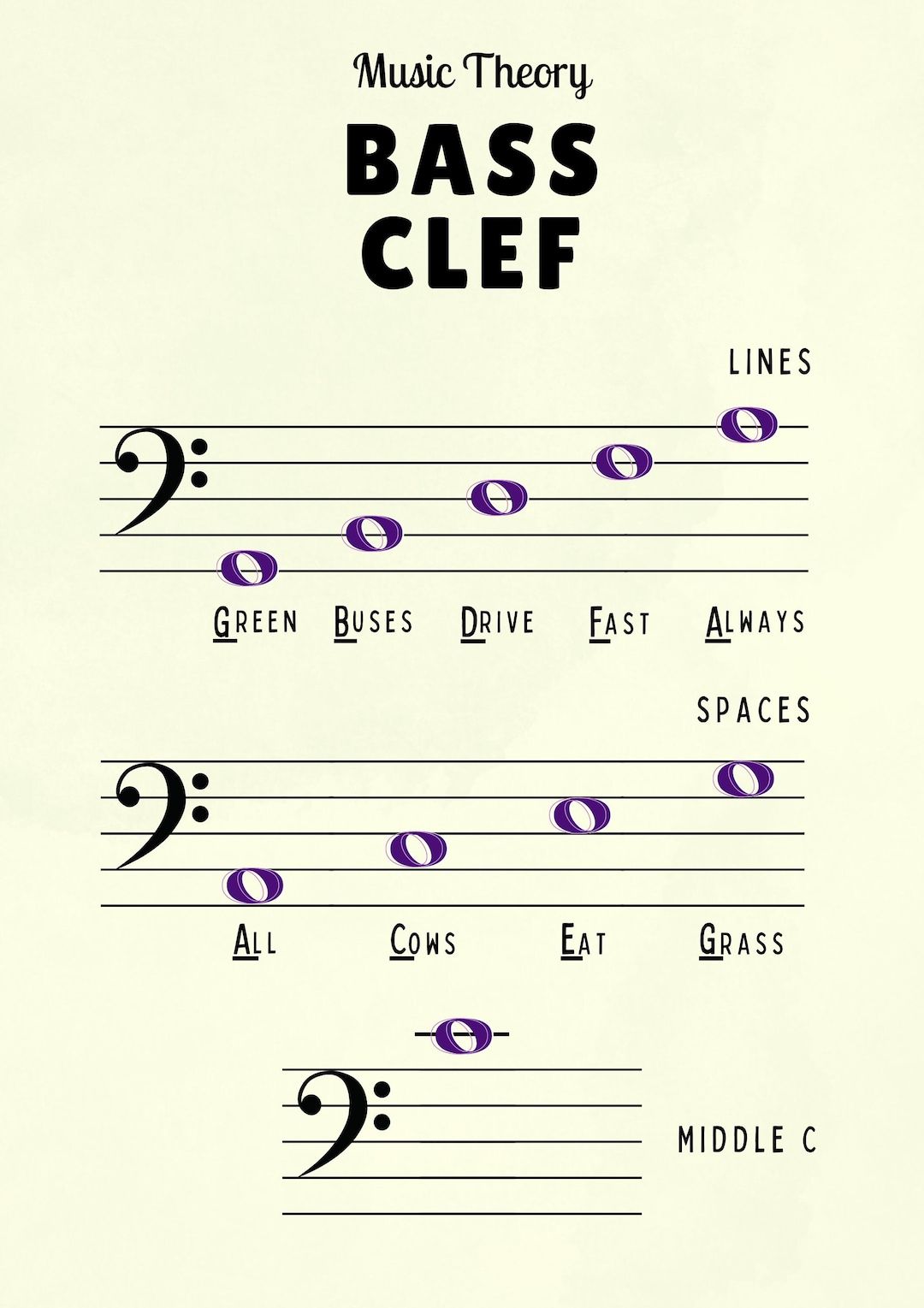
The horizontal stave-line surrounded by the top of that frown, or falling in the middle of the colon, is then determined to be an F natural (Ibid).
Open: Pasted image 20250425173746.png
C clef
This clef centers whatever horizontal stave-line “is to be designated as middle C¨ (Gould 2011, 6). It also has a shape that looks like a thick vertical line, followed by a thin vertical line, and then a rather strange “3¨-shaped line.
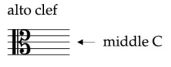
This clef also has sub-categories based on what it has designated as middle C.

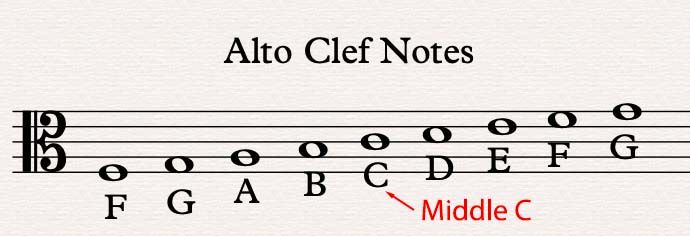
From bottom to top then, the subcategories are (Ibid):
- Soprano, wherein the fifth stave-line is middle C
- Mezzo-soprano, wherein the fourth stave-line is middle C
- Alto, wherein the third stave-line is middle C
- Tenor, wherein the second stave-line is middle C
- Baritone, wherein the first stave-line is middle C
Open: Pasted image 20250425174247.png
Percussion Clef
This clef consists of either two filled rectangles, or a sharp-angled “C¨ shape, that takes up stave-spaces in size. They indicate that the stave contains notes of indefinite pitch (Gould 2011, 6).
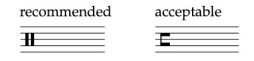
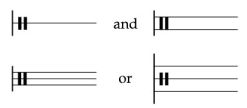
It is optional to use it for staves of less than five lines given that such staves tend to be for purposes in which pitch is or would be irrelevant (refer to 20250119131204-Staves) (Ibid).
treble_clef G_clef bass_clef F_clef tenor baritone alto mezzo-soprano soprano C_clef stave_space stave_line stave_lines musical_notation musical_note music_theory
bibliography
- “Ground Rules.” In Behind Bars: The Definitive Guide to Music Notation, 3–45. London, UK: Faber Music, 2011.