Clef Alterations on Staves
For background on what a clef is, see 20250119133124-Clefs.
Clef Positioning in Systems
Any system should remain using one clef for as long as possible, by using at most three extra lines at either top or bottom (Gould 2011, 7). These extra lines on staves are called ledger lines and are typically twice as thick and only take up slightly more horizontal space than the horizontal space taken up by a transcribed note (Gould 2011, 26).
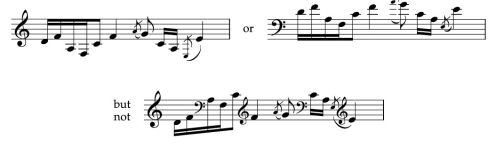
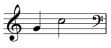
In addition, in a new system, understood this way, any clef beyond the initial clef at the start of the staff must have two-thirds the size of that initial clef (Gould 2011, 7).
The end of a system must signal the proceeding initial cleft of the next if that initial clef is different from its own most recent clef (Ibid). This is already exemplified in the image above, and more elaborately with the image below.

Clef Positioning for Bars
When there is a change a clef indicates across, or for, staves past a barline, that clef must precede the barline itself, even if there are some rests that can be transcribed that suspend the change indicated by the clef (Gould 2011, 8).

However, in some cases a clef change may remain appropriate mid-bar (i.e., somewhere along the segment of stave lines demarcated by the barline). If so, it is preferable to place it in-between beats and after any marked rests across beats in a bar (Ibid).

In the worst case scenario, at the very least position the change in clef within some subdivision of the beat or in-between phrases (Ibid).
ledger_lines stave-line stave_line stave_lines stave-lines music_theory musical_notation musical_notation
bibliography
- “Ground Rules.” In Behind Bars: The Definitive Guide to Music Notation, 3–45. London, UK: Faber Music, 2011.