Key Signature
From bib. source
That is for a stave:
The placement of accidentals at the beginning of a stave, on some stave lines, conveys whether a note is to be raised or lowered by a semitone, often to express a particular scale as the default for the musical composition (Kostka, Payne, and Almén 2018, 6).20250119131204-Staves
Staves
From “Ground Rules¨ in Behind Bars
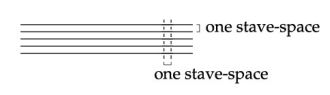
The size of every notational symbol is measured in proportion to the stave size. A stave-space is the distance between two stave-lines and is used as a measurement for notational symbols and spacing.
Staves can have any number of lines, but the most common conventional ones are the five-line and single-line staves. For the stave, lines run horizontally, and have equal vertical spacing among them.
Single-line staves are used (Gould 2011, 5):
- To notate instruments of indefinite pitch
- To notate sounds of indefinite pitch (e.g., percussive sounds) produced on pitched instruments
- To notate vocal sounds of non-specific pitch
- To notate a cue line of rhythm
- As an option to show approximate pitch
Staves and the musical alphabet
Stave-spaces and stave-lines together vertically represent some segment of the looping sequence of the musical alphabet.
five-line_staves five-line_stave single-line_stave single-line_staff stave_lines stave_line stave-line stave_space music_theory musical_notation stave staves staff loop musical_notation musical_note musical_notes music_theory
bibliography
Link to original
- “Ground Rules.” In Behind Bars: The Definitive Guide to Music Notation, 3–45. London, UK: Faber Music, 2011.
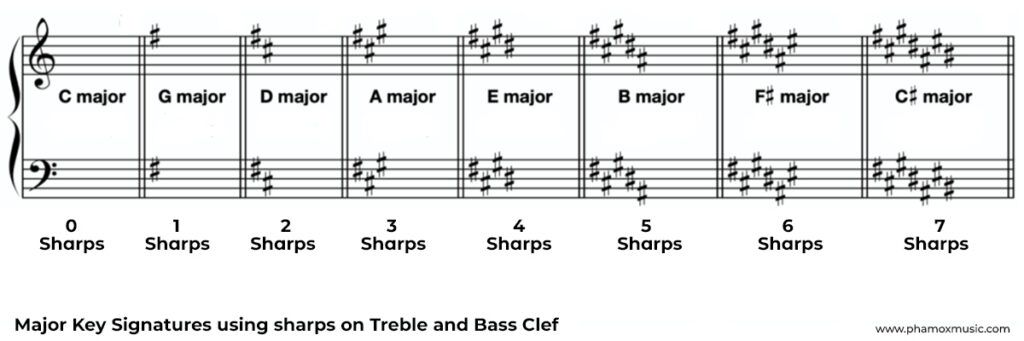
Another way of looking at key signatures is as a tool for converting a scale into another scale pattern while retaining the same key, such as converting a scale of G key that uses only all white keys to a major scale by adding an accidental, in this case a sharp accidental, to an otherwise natural note (Kostka, Payne, and Almén 2018, 5-6).
Letter name conservation
Major and minor scales in particular always use all the letter names of the musical alphabet (Kostka, Payne, and Almén 2018, 6). It “would not be correct to substitute a G♭ for the F♯ in a G major scale,” as this would lead to a redundant letter name (Ibid).
key_signature stave_line stave_lines stave-line stave-lines music_theory musical_notation major_scale minor_scale sharp_accidental flat_accidental musical_composition scales keys notes accidentals semitone semitones
bibliography
- “Fundamentals.” 2018. In Tonal Harmony: With an Introduction to Post-Tonal Music, by Stefan Kostka, Dorothy Payne, and Byron Almén, 8th ed., 1–65. New York: McGrawHill Education.