Interval of a 4th
From “The 4th¨ in Music Theory for Electronic Music Producers
The interval of a 4th doesn’t get used very often in chords. That is, a triad with a 4th in it. That would make it clash with the 3rd […] The 4th by itself though has a very interesting tendency. It tends to want to move some place else. […] It sounds unstable like it wants to move to another place. […] 4ths tend to want to fall down to a 3rd.
The interval of a 4th is the space, move or span of an inclusive count of 4 (mechanical) keys or their corresponding pitches from a musical key of a musical scale up or to the right of a standard Western classical piano keyboard or piano roll editor. In sum, it is an inclusive distance of 4 diatonic (mechanical) keys or their corresponding pitches. The half-step distance in chromatic keys may vary. The below exemplifies a 4th with a perfect quality starting from a G in the key of a C major scale (refer to 20240904103821-Musical_Scale_and_Key_Patterns & 20240903174948-Being_“In_Key”), which chromatically requires 5 half-steps (refer to 20240831190951-Musical_Alphabet & 20240831200842-Musical_Accidentals).
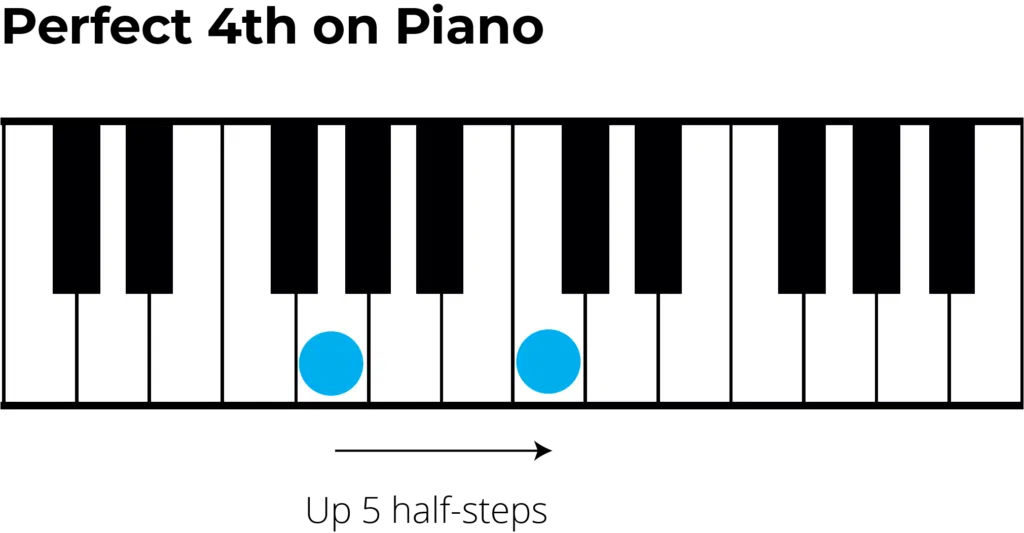
As mentioned here, the interval of a 4th has an intrinsically tense sound that must “release¨ its expressive energy by “climbing down,¨ notably by shifting to an interval of a 3rd existing below it on a piano roll editor or to its left on a standard Western classical piano keyboard.
Needless to be said, the interval of a 4th is an inversion of the interval of a 5th (refer to 20241007141701-Interval_Inversions).
piano_roll_editor musical_scale musical_key chord chord_quality perfect_fourth major_third minor_third perfect_interval interval_quality half-step semitone major_scale C_major_scale pitch music_theory semitone perfect_4th_interval
bibliography
- “The 4th.” In Music Theory for Electronic Music Producers: The Producer’s Guide to Harmony, Chord Progressions, and Song Structure in the MIDI Grid., 1st ed., 94. Minneapolis, MN: Slam Academy, 2018.