Fingering in Composite Chordophone Playing
From “Tutorial¨ in The Bass Handbook
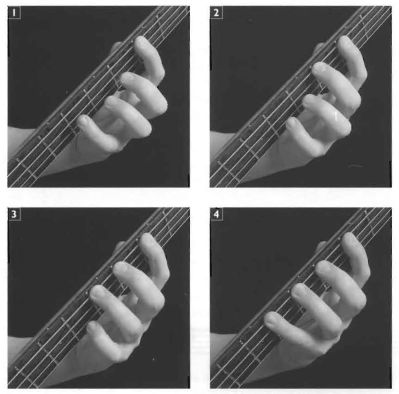
Supportive fingering is a concept that will help strengthen your fretting hand and give good dexterity. The starting point is to achieve a fretting-hand position in which each finger is holding down one fret. As with all good ‘rules’, there are exceptions: repeating octave or root/fifth patterns, extended fingering, and double-bass technique are all examples.
How does one achieve a fretting-hand position “in which each finger is holding down one fret¨ (Ashton 2005, 129)? Well, the following tips will put this together (Ashton 2005, 130):
- The thumb is placed behind the neck, perpendicularly halfway down the neck, and especially further down than the first or second fingers on the other side of the neck
- Fretting fingers are placed slightly behind each fret, not directly on or in-between frets
- Previous fingers should be left down as each new note is played
Figures 1-2 from “Tutorial¨ in The Bass Handbook
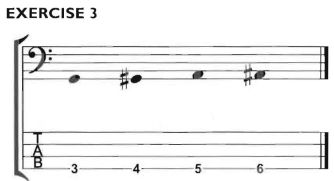
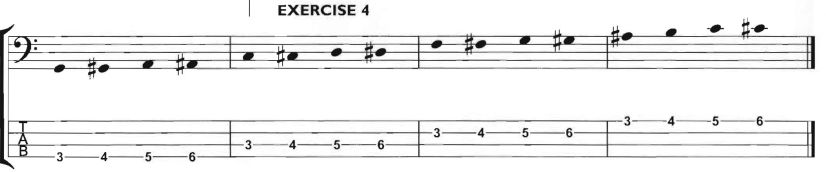
The following exercise should become easy prior to moving onto the exercise after it (Ibid). Both exercises, however, are meant to condition the supportive fingering technique (Ibid). Make sure to apply, then, the supportive fingering technique when doing these.
Exercise 3 from “Tutorial¨ in The Bass Handbook
Exercise 4 from “Tutorial¨ by The Bass Handbook
For background, refer to 20240831190951-Musical_Alphabet and 20240831200842-Musical_Accidentals.
supportive_fingering music bass_guitar bass guitar composite_chordophone strummed_string_instrument plucked_string_instrument musicology composite_chordophone_frets plucked_string_instrument_frets strummed_string_instrument_frets fretboard fret frets string composite_chordophone_neck plucked_string_instrument_neck strummed_string_instrument_neck fretting
bibliography
- Morrish, John, ed. “Tutorial.” In The Bass Handbook: A Complete Guide for Mastering the Bass Guitar, 1st ed., 121–238. San Francisco, CA: BackBeat, 2005.