An interval is a scalar value for pairs of events/objects among a set of objects or events, or a proportional relationship for pairs of vectors of a set of phenomena.
Typically, the word “interval” is used when such vectoral proportions or scalar values between pairs among a set is true for any possible pair from that set, and the elements of that set share the same category.
In scales, acoustic frequencies are conventionally ordered from lowest to highest, though other sequences may be derived from scales when the acoustic frequencies of a scale are treated as an unordered set to sample from.
Sometimes “chromatic” is used to refer to the pitches found in 12 equal temperament, i.e. the division of an octave into 12 equally “tempered” (i.e., equally spaced) parts, when such pitches are pooled together.
An octave is an acoustic frequency interval between pitches wherein one frequency of one of the pitches is half or double the frequency of another of the pitches, or that is when a given pitch has an acoustic frequency interval of 1:2 / 2:1 (see 20240901153645-Musical_Octaves)
It is called an octave due to their being 8 pitches (inclusively counted) within its interval that sound “in key” (see 20240901153645-Musical_Octaves)
By in key is meant that each of the pitches of the scale have consonance, i.e. sound like they cooperate seamlessly and pleasantly, with at least one pitch in that scale (see 20240903174948-Being_“In_Key”)
When building a scale, a set of interval relationships is not enough as the order of those interval relationships and where in the range of frequencies one starts to apply it is unknown; often, the latter is specified by that pitch which every pitch in the scale would be consonant with, known as the root key of the scale (see 20240904101419-Root_Keys), while the former is specified by the kind of scale it is. This is known as the scale’s interval quality.
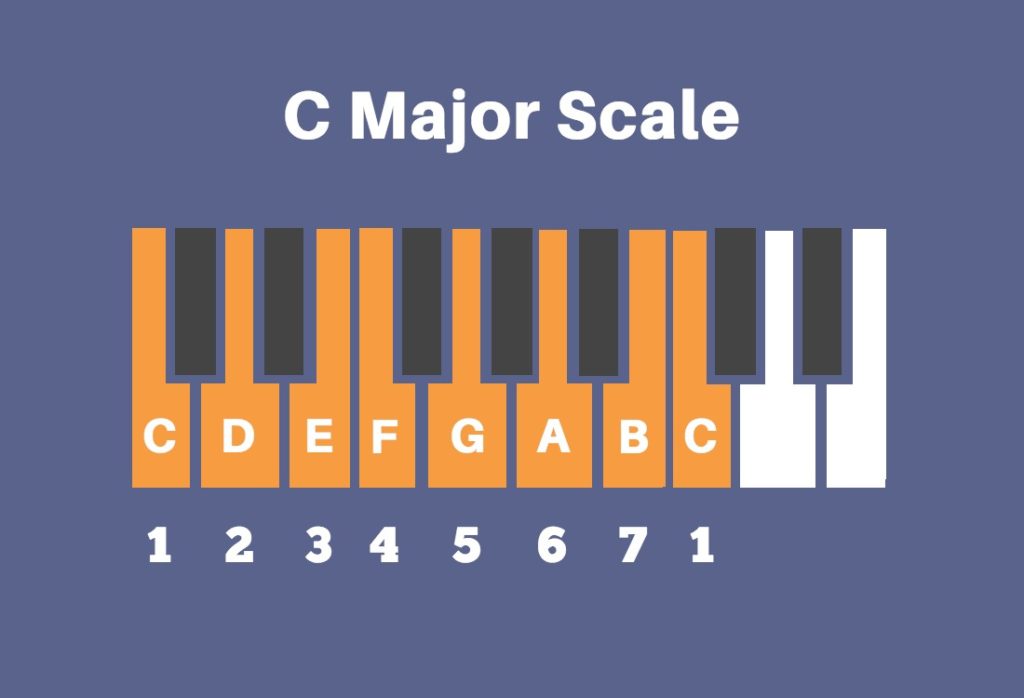
Example: C major scale is a scale major interval quality, which tells you the set of interval relationships and their sequential application, and a scale that is in the key of C, which tells you from where to start the sequential application of the intervals for the major scale (again, see 20240904103821-Musical_Scale_and_Key_Patterns)
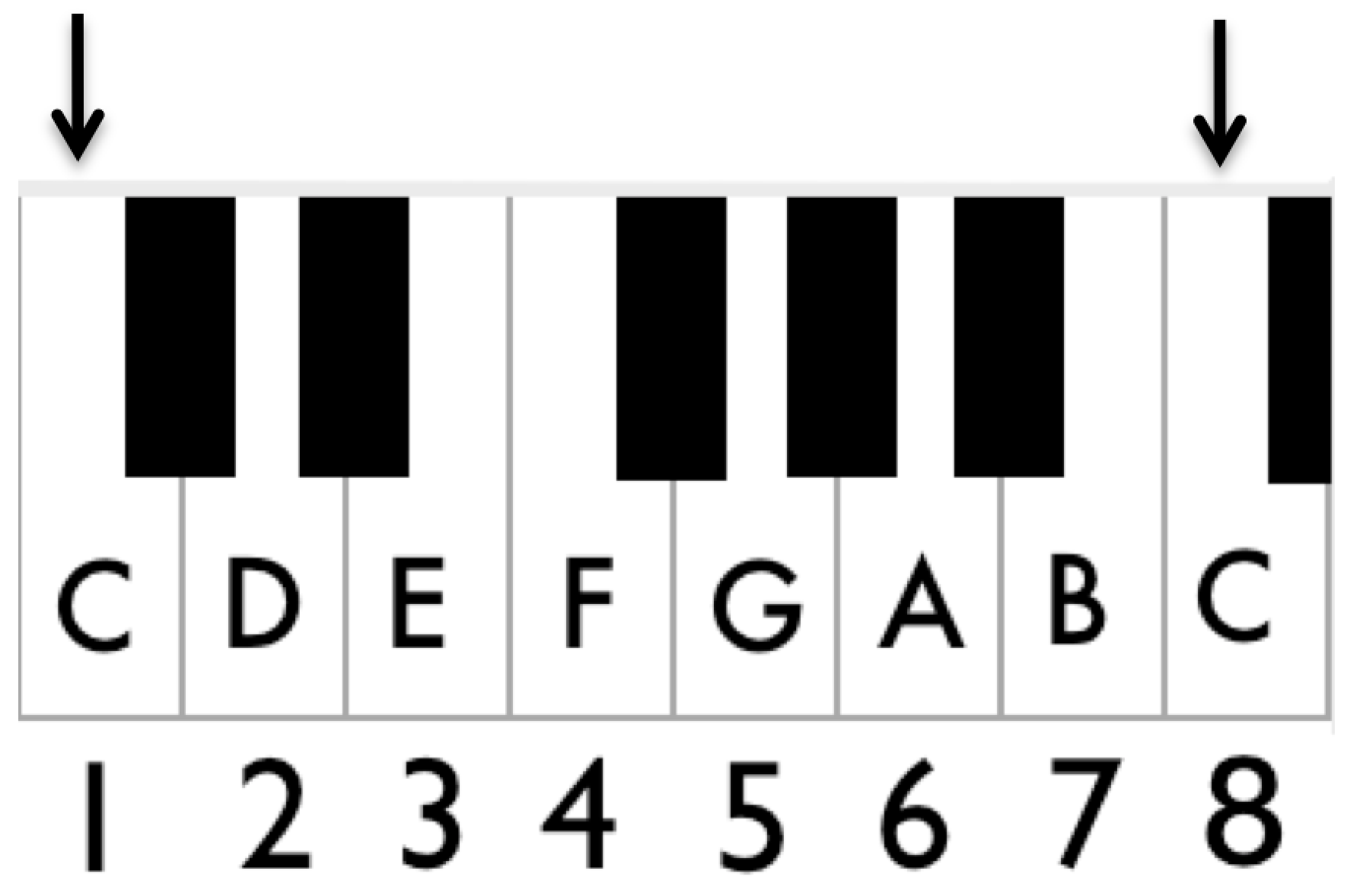
One knows what the C in “the key of C” refers to because of the fact that pitches from 12 equal temperament, found within the octave, have been labeled according to the mechanical keys of Western classical pianos that use standard tuning matching that very pattern. The white keys of such pianos are labeled in a looping fashion starting from C, the first white key directly preceding two non-consecutive black keys, and going through the alphabet until G, after which it starts at A until ending in C again, starting the same sequence. This sequence of letters (i.e., CDEFGABC) that label pitches according to that sequence of white keys is known as the musical alphabet. The pitches in C major scale maps one-to-one onto the musical alphabet and vice versa.
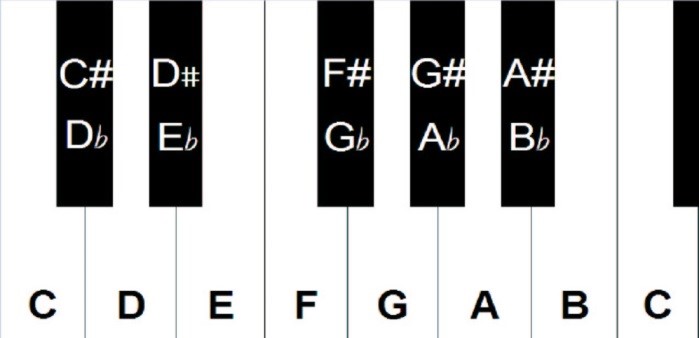
The pitches from 12 equal temperament, found within the octave, can be sorted into the naturals and the accidentals: a natural is any pitch in the C Major scale, whereas an accidental is any pitch from the 12 equal temperament that is not included in the C major scale. The former corresponds to the white keys on a Western classical piano with standard tuning, while the latter corresponds to the black keys on a Western classical piano with standard tuning (see 20240831200842-Musical_Accidentals).
Any given accidental is labeled according to the musical alphabet label of any nearest natural so long as its status as either having a pitch lower or higher than that natural is specified by describing it, respectively, as either flat or sharp (see 20240831200842-Musical_Accidentals). If flat the musical alphabet letter is appended with the “♭” symbol, and if sharp it is appended with the “♯” symbol.
Any set of pitches that share the same musical alphabet and accidental (or lack thereof) for their label can be considered to be of the same note, even if they have different pitches due to existing within different octaves, because all of them in that case have the same interval relationships in and for their respective octave.
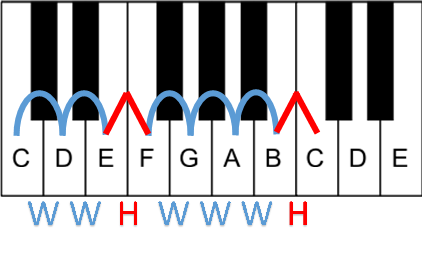
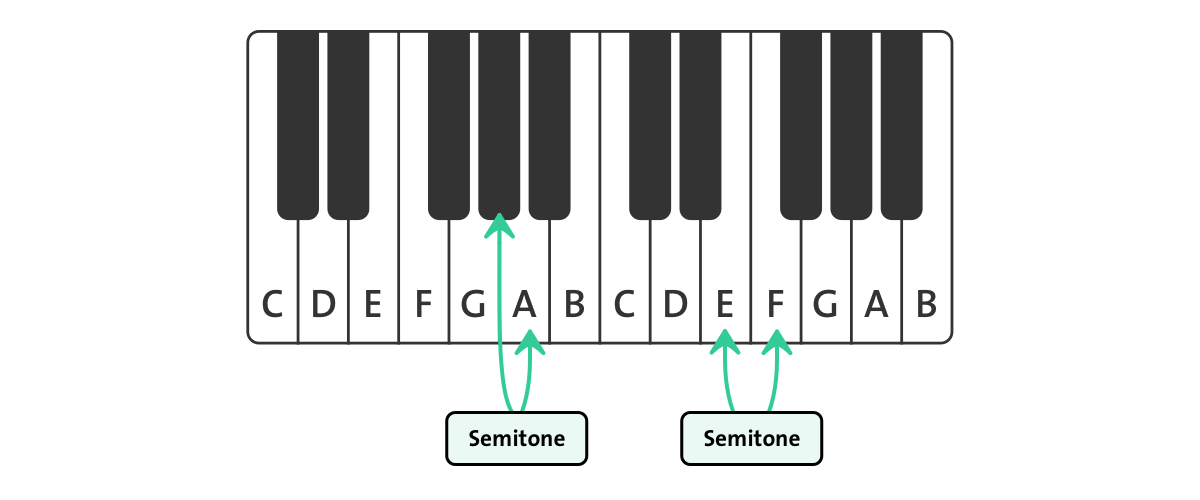
The unit of measurement for intervals in Western music theory is itself derived from the aforementioned 12 equal temperament, i.e. division into 12 equal parts, of the octave–the interval between any two adjacent pitches of 12 equal temperament is called a semitone (see 20240831183733-Semitones) whereas a movement a semitone “distance” from one pitch to another is called a half-step (see 20240901015045-Semitones_and_Half-steps). Two semitones are equal to a whole tone (see 20240901015508-Whole_Tones), and a movement a whole tone “distance” from one pitch to another is called a whole step.
A scale that is “in a key” and whose pitch interval relationship sequence is of a certain kind can have each of its consequent pitches labeled by its ordinal number in sequence from the root key (that pitch from the scale that all other pitches are consonant with). The root key of a scale is the same as that pitch it is in the key of, e.g. the root key of C major scale is C. This ordinal number label is called the scale degree of the pitch (see 20240904131349-Scale_Degrees).
Scale degrees are important for analyzing or building chords from any scale that is in a key and has a given interval pattern. A chord is a group of unique notes that are to be played, whether together or in a sequence (see 20240924121346-What_Chords_Are). While one can play in a given scale that is in a key, one does not play all the pitches in the scale as a whole as a group sequentially, but instead plays given combination of pitches from the given scale in the given key simultaneously or in some temporal order.
Conventionally, chords are of two types: triads, which use three unique notes, and diads, which use two unique notes (see 20240924121346-What_Chords_Are).
Chords can be built provided one selects a note from the given scale in a given key, which once selected is often called a root note or also called a root key for the chord (see Building a Chord).
Once a root note exists, the chord is built by applying a sequence of intervals on the given scale that is in a key. These intervals, however, are measured relative to that given scale in its given key, and thus their basic unit of measurement is the aforementioned scale degree rather than the semitone. The conventional sequential interval pattern for intending the next two notes in a triad is to count two scale degrees over from the root note twice (see Scale Degrees and Triadic Chord Construction).
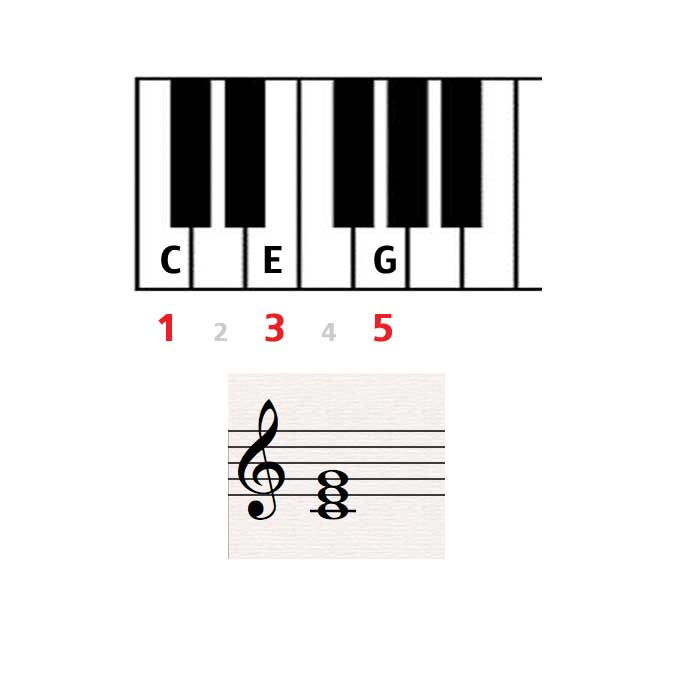
Example: building a triad from a root note of C from a major scale in the key of C would result in notes at scale degrees i=1 (C), i+2=3 (E) and (i+2)+2=5 (G) getting used in the triad.
Using a triad with a C root note from a C major scale leads to scale degrees 1, 3 and 5 being used. The names for each note in a triad, regardless of what the root note specifically is or with what scale in what key one is working, ended up conventionally being the first, the third and the fifth due to this (see Scale Degrees and Triadic Chord Construction).
While triads are built through interval patterns measured by scale degrees and their notes are also named based on an instance of a scale degree pattern, intervals measured in semitones remain relevant for contrasting triads that otherwise share the same scale degree pattern. When two chords of the same scale degree interval pattern have different semitone interval patterns, one says that they have different interval qualities (see Chromatic Interval Variability of Diatonic Chords).
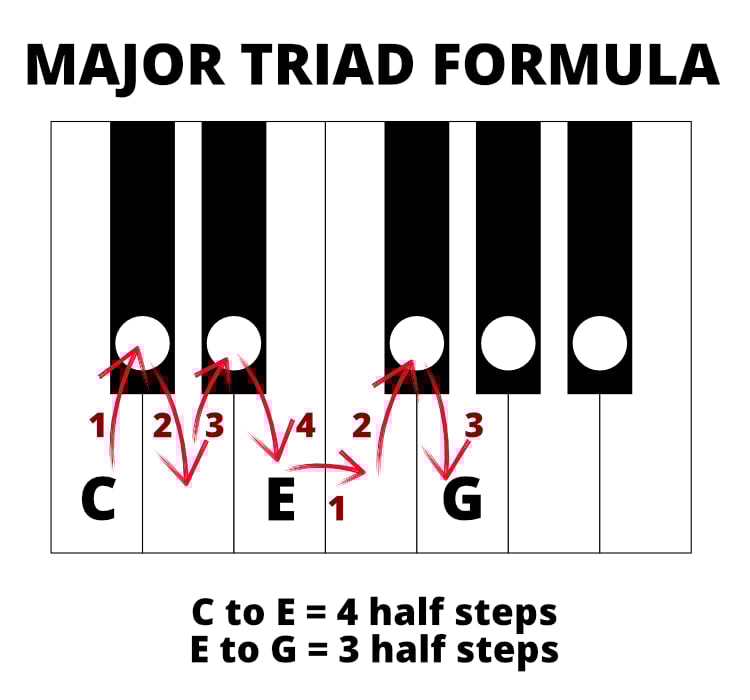
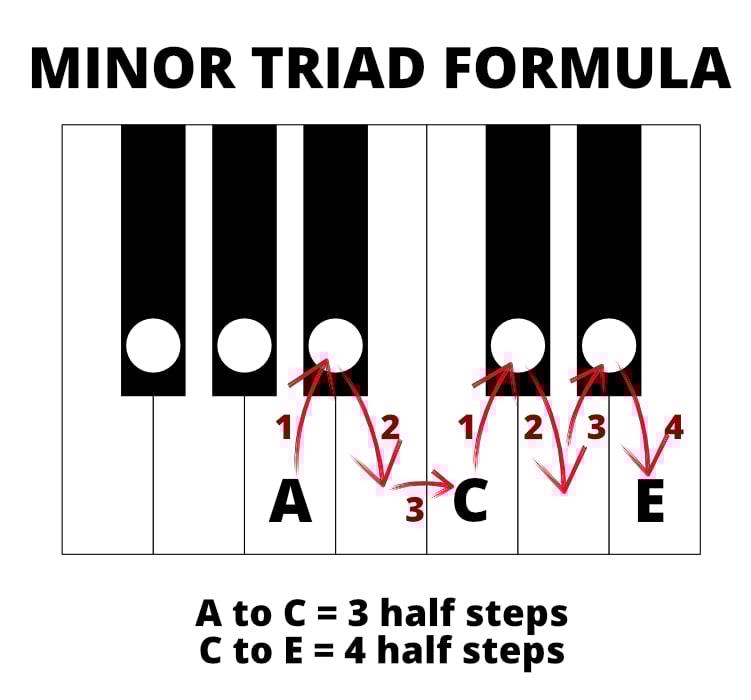
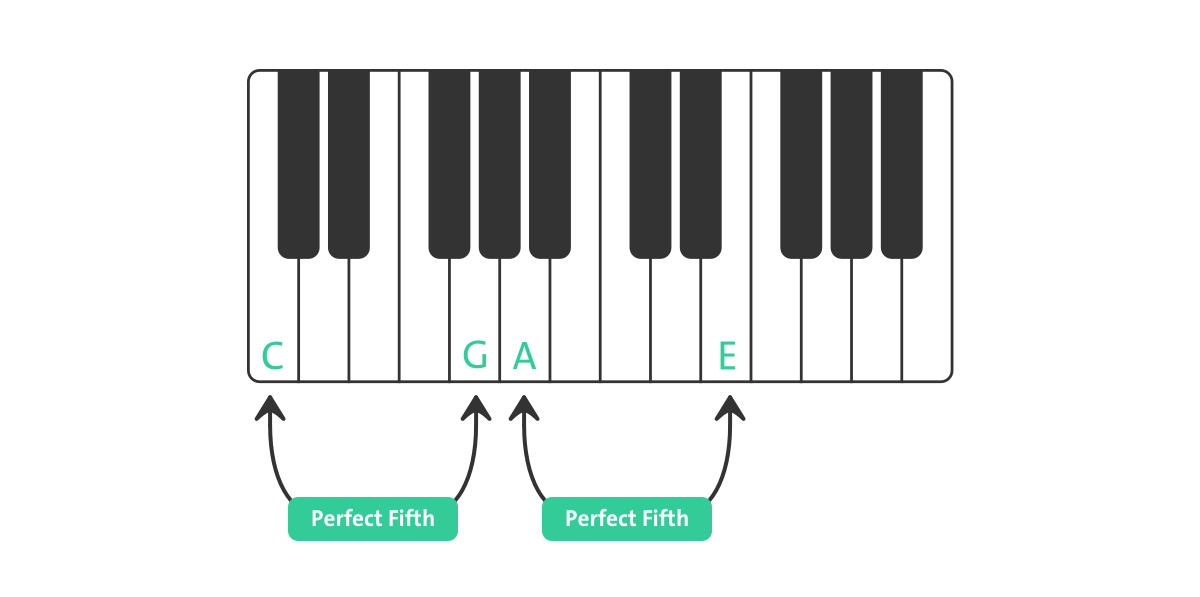
Having a major interval quality, for chords, means the first and third of the triad are four semitones apart and the third and fifth of the triad are three semitones apart (i.e., it means that the triad has a 4:3 semitone interval ratio). Having a minor interval quality, for chords, means the first and third of the triad are three semitones apart and the third and firth of the triad are five semitones apart (i.e., it means that the triad has a 3:4 semitone interval ratio) (see Chromatic Interval Variability of Diatonic Chords). A 4 semitone interval distance from the center of a triad is called a major third, while a 3 semitone interval distance from the center of a triad is called a minor third (see 20240928130915-Two_Thirds_in_Triads). A perfect interval quality, for chords, means the amount of semitones in a scale degree based interval is invariant, and this applies to an interval of a fifth. A diminished triad is one that has two minor thirds, while an augmented triad is one that has two major thirds.
Example: If one extracts a diad from a triad’s first and fifth, then what would have otherwise been the fifth for the diad can be said to have a perfect interval quality. This is why the fifth of a triad is often called a perfect fifth, as one can create a diad and then add what would be the third to create a triad with a given interval quality (see Building Triadic Chords from Diatonic Perfect Fifths).
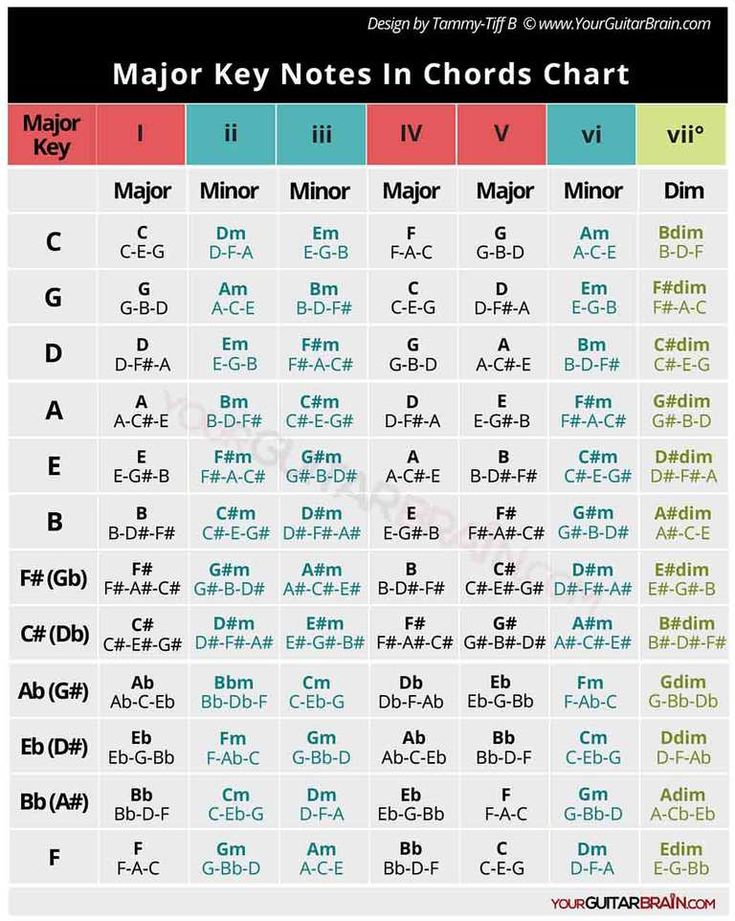
All triads derived from any scale in a given key can be labeled according to the scale degree of their root note, provided it is expressed in roman numerals. Chords bigger than a triad can have the triad of their root note expressed as before, but now with arabic numerals appended that express what interval(s) needs to be inserted to morph the triad into the proper post-triadic chord. Capitalization and degree-sign (as in Fahrenheit) superscripting of the roman numeral conveys its interval quality: lower-case without superscripting is minor, lower-case with superscripting is diminished, and upper-case without superscripting is major. This is called the roman numeral system of chord notation.
The bigger the chord, the more interval qualities it is likely to introduce.
Scale degrees also have distinct names in addition to being labeled according to their ordinal value. Scale degree 1 is the tonic (the home of the scale), scale degree 2 is the supertonic (barely leaving home, might collapse back int home), scale degree 3 is the mediant (useful for pivoting or shifting interval quality), scale degree 4 is the subdominant, scale degree 5 is the dominant (a neutral suspension in time, transient), scale degree 6 is the submediant, scale degree 7 is the leading tone (guides us right back into home). These names are not just arbitrary but are supposed to describe the function or role each scale degree can play in a chord or chord progression (hence the parentheticals) (see 20240904145213-Supertonic_Scale_Degree, 20240904150953-Mediant_Scale_Degree, 20240904153312-Subdominant_Scale_Degree, 20240904154815-Dominant_Scale_Degree, 20240904161116-Submediant_Scale_Degree, 20240904162744-Leading_Tone_Scale_Degree).
A diatonic chord progression is a sequence of chords derived from a given scale in a given key (see 20240927133630-What_is_a_Diatonic_Chord_Progression). There is a pattern for selecting all chords that reside inside a given scale in a key, wherein one goes sequentially by scale degree to get each root note from which a chord may be derived (see 20240927133630-What_is_a_Diatonic_Chord_Progression). The chord sequence (or chord progression) derived from this pattern also conveys the resulting interval qualities of each of those chords. Provided the scale interval quality stays the same but the root key changes (i.e., provided a set of relative scales), there is no variation in the interval quality for each of the chords in the chord progression (using our standard selection pattern aforementioned) for those scales (see 20241026193255-What_are_Relative_Scales).