Musical Octaves
From “What Are Octaves?¨ in Music Theory for Electronic Music Producers
Octave means a group of eight notes. If we count from C4 to C5, those eight notes would be: C4, D4, E4, F4, G4, A5, B5, C5. We only include notes that are in key when counting the notes of an octave. We haven’t talked about what being in key means yet, so for now, just remember that the key of C is easy because it only includes the white notes.
An octave, then, is a sequence of keys that are “in a key.¨ Generally, due to the letters of the musical alphabet, any sequence of keys starting on or with a given key will also end on that key. Hence, we can also treat an octave as a type of interval unit to measure the distance between keys of the same type (that is, same type according to their letter label from the musical alphabet). As we see in the sequence in the quote above, an octave above or to the right of C4 is C5, within the “key of C.¨
Note
Important
Here one can now see also that the number appended to the first letter label beginning the octave interval serves to indicate which octave group in a sequence of octave groups the key or note of that letter label can be found in.
Question
Frequency Ratio
You may notice that “octaves have a sound to them¨ such that “they sound like they fit together¨ (Allen 2018, 36). This is because “an octave is always a ratio¨ (Ibid). (In this case, “octave¨ is being used as an interval, while the keys are being talked about in terms of their expected sound frequency; in other words, what is being said is that two sound frequencies an octave frequency range apart are expected to have a or frequency ratio.)
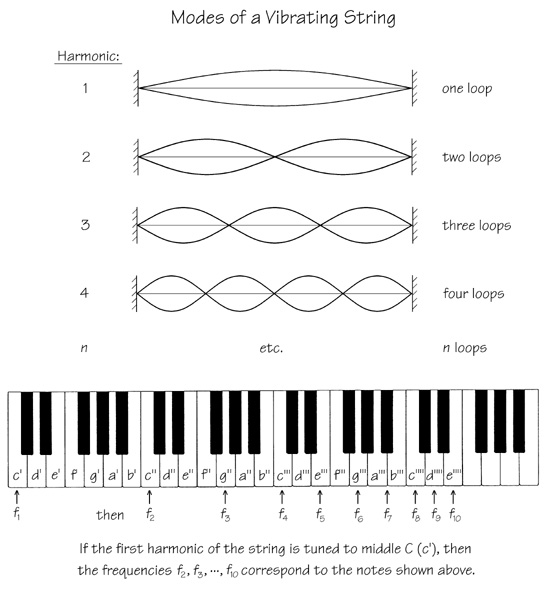
Reference image to study:
interval music music_theory musical_alphabet
bibliography
- “What Are Octaves?” In Music Theory for Electronic Music Producers: The Producer’s Guide to Harmony, Chord Progressions, and Song Structure in the MIDI Grid., 1st ed., 35. Minneapolis, MN: Slam Academy, 2018.