Ambiguities of the Key in Music
What is a Key?
For the word “key,¨ this is made clear by the fact that often “key¨ in music discourse is used to refer to the literal keys of the standard Western classical piano keyboard , as this is often the instrument that is used to communicate and transfer musical concepts (see 20240831190951-Musical_Alphabet & 20240831200842-Musical_Accidentals). The main reason for this is convenience.
However, insofar as information about music is delivered by using the signifiers of the musical alphabet and musical accidentals, sometimes these signs modify the word “key.¨ We see this in such discussions as the following:
20240901115917-Locating_C_Piano_Key
Locating C Piano Key
From “Locating C¨ in Music Theory for Electronic Music Producers
The pitch C will always be the white key to the left of a group of two black keys. […] No matter what kind of keyboard you are looking at it, or what kind of sequencer, the location of C will always be the same. The only difference is that when we look at our Piano Roll Editor, the C is under the group of two black notes (remember that left means lower on the piano), because the piano is laid out vertically.
Note
Eureka
Nonetheless, one ties the pitch to the key for ease in conveying that pitch. More accurately, “C¨ then refers to the expected pitch of a key labeled such. “C¨ is a relationship between a key and a pitch, rather than merely one thing or the other.
Reference image:
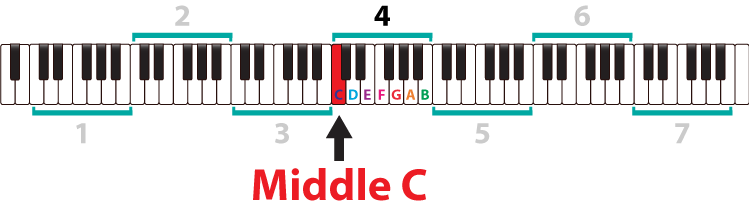
Once you know how to locate C, you are then able to find middle C:
20240901142025-Middle_C
Middle C
From “Middle C¨ in Music Theory for Electronic Music Producers
In addition to the letter name C, there is a number. That number indications[sic] which C we are looking at. On a keyboard (depending on the size of the keyboard), we might have six or seven different C keys. […] Middle C is the C key that is right in the middle of the keyboard. Technically speaking, middle C is C4.
Simply spoken, conventionally, middle C is C4. To know how to find C more generally, refer to 20240901115917-Locating_C_Piano_Key.
Caution
There can be “some confusion¨ in finding C4 as smaller keyboards wherein the musical alphabet and its accidentals repeat only once or twice can have buttons that allow us to shift the auditory frequencies produced by those keys down or up (Allen 2018, 31). (However typically the default has C4 as the either at the beginning or start of that small keyboard.) Furthermore, confusion is exacerbated by “synthesizer manufacturers about middle C¨ as some “label middle C as C3¨ (Ibid).
Reference image:
music music_theory Western piano classical C4 middle_C C3 musical_alphabet
bibliography
Link to original
- “Middle C.” In Music Theory for Electronic Music Producers: The Producer’s Guide to Harmony, Chord Progressions, and Song Structure in the MIDI Grid., 1st ed., 31. Minneapolis, MN: Slam Academy, 2018.
pitch music music_theory piano_roll_editor musical_alphabet key keys C
bibliography
Link to original
- “Locating C.” In Music Theory for Electronic Music Producers: The Producer’s Guide to Harmony, Chord Progressions, and Song Structure in the MIDI Grid., 1st ed., 30. Minneapolis, MN: Slam Academy, 2018.
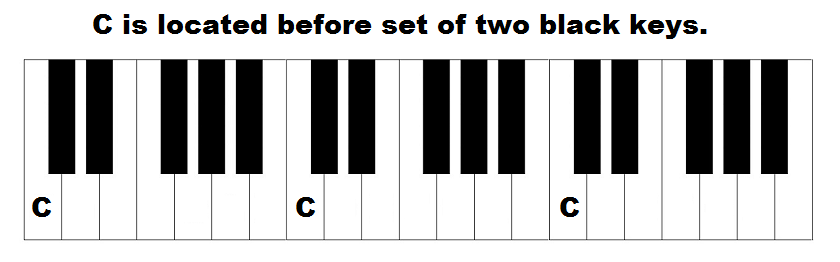
Here we see that on the one hand what it means for a literal standard Western classical piano key to be C is that it has a pitch C. And yet, if for example a piano roll (refer to 20240901152320-MIDI_Middle_C) were detuned (refer to 20240901112354-Oscillator_Detune_Kob) or had its mapping moved amount of semitones (refer to 20240831183733-Semitones & 20240901101954-Oscillator_Semi_Knob), we might still call a literal key on it without the pitch C a C key. What work is C doing there then? It would seem it is still not clear what makes a literal key as seen on a standard Western classical piano a “C,¨ “D,¨ or other kind of key, unless the word ¨key” itself is ambiguous or the musical alphabet and its accidentals were capturing an ideal rather than actual relationship between a pitch and a key. I think taking the former approach is easier, as the latter would require discussing how the musical alphabet and its accidentals is regulating this mapping of pitches to keys, as well as to musical notes.
Notes
“Notes¨ as in musical notes is another ambiguous word, sometimes used interchangeably with keys or pitches.
A Key as a Mechanical Key
To start with, we can call this type of literal key we point to on, e.g., a standard Western classical piano a mechanical key, and generalize the function of a mechanical key beyond its paradigmatic instrument within the scope of music and musicality. A mechanical key is any mechanism, though typically physical, for controlling the emission of a distinctive or distinguishable sound.
A Key as a Normative Mechanical Key
However, our definition of “mechanical key¨ reveals that labeling a series of mechanical keys, as with the musical alphabet and accidentals on the standard Western classical piano, is not enough for the replicability of given configurations of sound, and thus the transfer of skills in sound manipulation. The mechanical key can have varied implementations. Implicit, then, in music instruction using the practical reference to mechanical keys is the reliability and consistency of its implementation in accord with the factors relevant to music performance and production. So the word “key¨ sometimes refers to mechanical key and other times refers to certain related phenomena in music performance.
In addition, at the same time, as soon as one starts giving mechanical keys labels, as in the musical alphabet and its accidentals (refer to 20240831190951-Musical_Alphabet & 20240831200842-Musical_Accidentals), it allows one to talk about aspects of musical production or performance independent of the given implementation of mechanical keys to some degree.
So, on the one hand, music instruction requires replicability through the reliability and consistency of the implementation of mechanical keys, yet on the other hand music instruction requires abstraction of any given implementation of mechanical keys for musical discourse. The word “key¨ can therefore shift to mean an ideal or normative mechanical key.
A “key,¨ and consequently music in general, in such a case, can only be known or can only be an object of knowledge if certain aspects or parameters of sound are specifically selected to be isolated for purposes of control in the implementation of a series of mechanical keys, and these control-delegated isolated aspects of sound exist along a shared dimension such that they can be ordered and compared. This could be ordered and compared in absolute or relative terms.
Musical Epistemology and Normative Mechanical Keys
In the standard Western classical piano, the aspect, feature or parameter of sound chosen for control purposes was the pressure frequency of air responsible for differences in auditory quality. The frequency of sound can be measured, and thereby compared and ordered, along a dimension that all sounds share. However, as it is not possible to discretely convey every possible frequency level of sound through mechanical keys (and it would not be useful to do so anyway since some frequencies may be inaudible), consistency and reliability is not just achieved by using sonic frequency as a standard object of control. In this case it is achieved by additionally setting a standard pattern in the frequency relationship among selected sonic frequencies. So, what is needed for musical knowledge to be possible is the following:
- A sensory experience that changes in a way correlative to the frequency/amplitude of an air medium or a frequency in or scale of an air-related event in time; it seems clear that music has something to do with sound, which has this nature.
- A standard object of control that is some dimension of sound (i.e., measurable, ordered, comprised of possible directions and thereby comparable); we see, for example, that an oscillator detune knob (refer to 20240901112354-Oscillator_Detune_Kob) adjusts the sonic frequency of a sound, and so that is its object of control.
- A conventional starting or reference point in the given dimension that is the standard object of control; this is seen in the concept of middle C or C4 (refer to 20240901142025-Middle_C) in Western music theory and the process of tuning on A5 (refer to 20240901153645-Musical_Octaves & 20240901143827-Pitch_of_Middle_C).
- Standardization of repetitive, patterned or proportional relationships across the dimension (i.e., among points along the dimension) that is the standard object of control for sound, at some level of resolution, emphasized or chosen due to the perceptual and sensory qualities they correlate with; we see this with the concept of intervals as well as consonance/dissonance (refer to 20240901171406-Musical_Intervals & 20240901160833-Consonance,_Dissonance_and_Sound_Frequency_Ratios).
- An implementation of a sequence of mechanical keys based on 1-4 (refer to 20240904103821-Musical_Scale_and_Key_Patterns).
Note
This means that, in theory, there can be music knowledge unrelated to sonic frequency, but to other aspects of sound.
A “key¨ thus can refer to a normative mechanical key, normative because it was created with a standard object of control that is dimensional, it has repetitive, patterned or proportional relationships with other points along that dimension, and its sound is able to be located along that dimension due to a selected fixed sonic reference point on that dimension.
The existence of a normative mechanical key is what allows labeling of mechanical keys to facilitate musical discourse and thereby produce musical knowledge. That is to say, mechanical keys are described as “C¨, “D¨, etc., according to what normative mechanical key they are.
A Key as a Register of Normative Mechanical Keys
Lets not forget that there is yet another sense of “key¨ that is related to tuning activity, wherein one seeks to be in so-called “key.¨ In this case, “key¨ refers not just to the conformity of a mechanical key to its normative version, as it is also often said of a series of sequence of keys, whether in time or otherwise, that they are “in key¨ or not. We already have some background on what this means:
Transclude of 20240903174948-Being_"In_Key"
Yet, how do we situate it in our fuller understanding of the other things “key¨ can mean? Are these other meanings incidental? Its clear that while being “in key¨ relates to whether the used normative mechanical keys are harmonious with each other, it also is always relative to a specific normative mechanical key. In other words, its not only a set of harmonious normative mechanical keys, but a set of normative mechanical keys that are harmonious because they were developed in reaction to one specific normative mechanical key.
I like to think of this as a register, in that we may choose normative mechanical keys we wish to make use of for music but there is a constraint on the amount and types of normative mechanical keys we can use. The amount in Western music theory is distributed by, or divided into, octaves (refer to 20240901153645-Musical_Octaves) or limited by the musical alphabet and its accidentals (refer to 20240831190951-Musical_Alphabet & 20240831200842-Musical_Accidentals). The types are contingent on the first arbitrarily selected normative mechanical key. Its why we often pair the language of “in the key of¨ C, D, E, etc., with a (musical) scale related phrase , e.g. “major scale¨:
20240904103821-Musical_Scale_and_Key_Patterns
Musical Scale and Key Patterns
From “The Pattern of a Key¨ in Music Theory for Electronic Music Producers
To find the note in any key, we always start with the root. After we have the root, we can apply a pattern made of half-steps and whole steps. This pattern is simply called the major scale. Once we’ve figured out the major scale, we will know all the notes in they[sic] key. The pattern is: W W H W W W H In this pattern, ‘W’ refers to Whole Step and ‘H’ refers to Half-Step.
A musical scale, then, can also be defined more accurately as, not just a sequence of (mechanical) keys or their pitches in order as in 20240903174948-Being_“In_Key”, but a pattern of intervals used for selection of (mechanical) keys and their pitches to comprise a key (qua “in the key of¨). These intervals are the measures half-step and whole step, as explained in 20240831183733-Semitones and 20240901015508-Whole_Tones.
Thus, the root key or root pitch “anchors¨ the scale by acting as the starting key/pitch of the pattern of selection the scale provides.
Reference image for the Major scale with C (natural) as root:
Hence, we get the key of C (Major) using the Major scale on the root C.
flowchart LR
A["Root pitch"] -->|Application of scale| C["Produced key"]
Note
“W¨ stands for “Whole Tone¨ or “Whole Step,¨ while “H¨ stands for “Semitone¨ or “Half-Step.¨
whole-step whole_step half-step root_key root_pitch musical_scale major_scale music music_theory
bibliography
Link to original
- “The Pattern of a Key.” In Music Theory for Electronic Music Producers: The Producer’s Guide to Harmony, Chord Progressions, and Song Structure in the MIDI Grid., 1st ed., 54. Minneapolis, MN: Slam Academy, 2018.
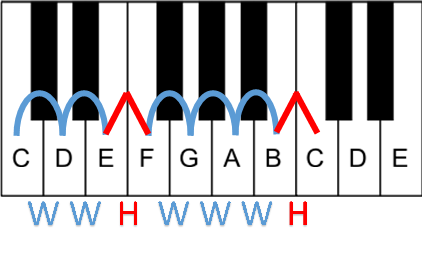
So, C major scale is a major scale in the key of C: that is, the given scale determines the complementary normative mechanical keys that sound good with and for the C normative mechanical key.