Tuning a Bass Guitar
To engage in tuning of a bass guitar, i.e. in the adjustments of the mechanism which it uses to produce sound so that those sounds are normative, in this case in their pitch . The video shows that there are two main kinds of bass guitars, a 4-string bass guitar and a 5-string bass guitar (How To Tune A Bass Guitar 2020, 00:58-01:56 & 02:22-02:38).
🎸 Open Pitches of the 4-String Bass
The musical alphabet letter notes (refer to 20240831190951-Musical_Alphabet) for the “keys¨ (i.e., strings) of the 4-string bass guitar (see 20240903174948-Being_“In_Key” & 20241013160314-Ambiguities_of_the_Key_in_Music), from thickest to thinnest or top to bottom key/string, are (How To Tune A Bass Guitar 2020, 00:58-01:56):
- E
- A
- D
- G
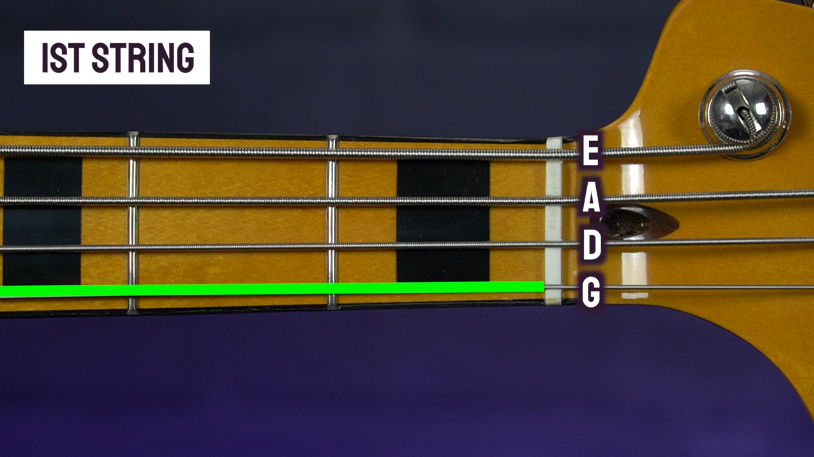
Image keymap
As apparent in the video, “1ST STRING¨ on the top-left corner of this image corresponds to the string on this bass guitar that has the green stroke over it.
Open string tuning process
Those more observant of the video will notice that the tuning process as explored so far happens by playing the given key/string without pinching down on any key/string against any fret of the fretboard. Playing a note/key like this on a string instrument or chordophone is referred to as playing an “open¨ key/string. One makes sure the pitch of such open keys/strings matches the normative pitch for them given their musical alphabet letter label.
Mnemonic device: Every Amazing Dancer Grooves
A mnemonic device for this sequence of keys/strings from top to bottom or thickest to thinnest key/string involves treating the sequence as an acronym that stands for: “Every Amazing Dancer Grooves.¨
Evaluating tuning
How can you tell if each key/string has a normative pitch corresponding to its assigned note? See 👂 Validating Normative Pitch.
🎸 Open Pitches of the 5-String Bass
For the 5-string bass guitar, the musical alphabet letter notes corresponding to its set of keys/strings have an added unique note in their sequence, located at the beginning provided the same order of top to bottom or thickest to thinnest (How To Tune A Bass Guitar 2020, 02:22-02:38):
- B
- E
- A
- D
- G
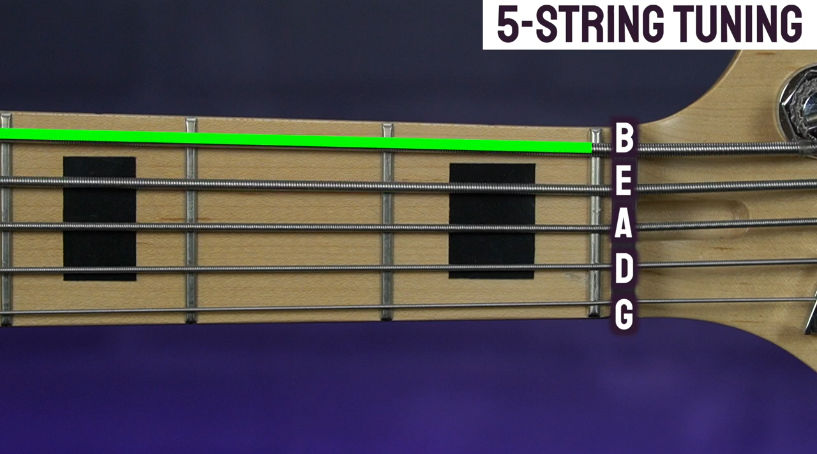
Image keymap
As apparent in the video, the key/string that has a green stroke over it simply indicates what key/string is being played in the video in that moment.
Caution
Remember! As mentioned for 🎸 Pitches of the 4-String Bass, one is presuming heretofore that the tuning process requires the use of open strings or open keys. That it is the open key/string sounds that we are listening for in order to match it to the normative pitch of our sequence of musical alphabet letter notes for those very keys/strings.
Mnemonic device: Basically Every Amazing Dancer Grooves
A mnemonic device for this sequence of keys/strings from top to bottom or thickest to thinnest key/string involves treating the sequence as an acronym that stands for: “Basically Every Amazing Dancer Grooves.¨ This draws on the mnemonic device from 🎸 Pitches of the 4-String Bass.
Evaluating tuning
How can you tell if each key/string has a normative pitch corresponding to its assigned note? See 👂 Validating Normative Pitch.
👂 Validating Normative Pitch
The video mentions in passing “tuning by ear¨ (How To Tune A Bass Guitar 2020, 02:38-02:49). This is a technique for validating that the pitch of the bass guitar key/string is normative, merely by intuiting via senses its similarity to the target normative pitch. It relies on verisimilitude as its logic. Just after mentioning tuning by ear, the video mentions the usefulness of electronic tuners (Ibid). Something that may look like such (Ibid):
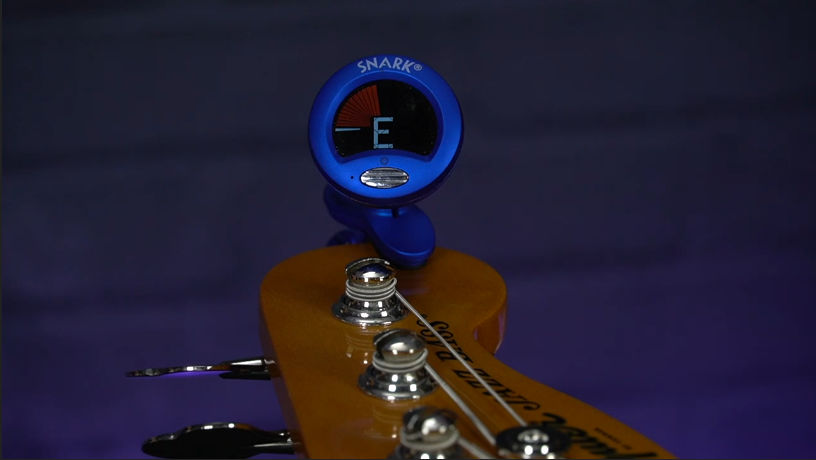
Smartphone as computational tuner
There are also smartphone applications that can detect the pitch of a key that has been applied and report it back, as well as applications specialized for tuning various instruments.
As one gets feedback on the pitch of the given key/string being played on the given instrument, in the case of the bass guitar one turns the corresponding knob handle to calibrate it towards the “correct¨ or intended pitch for that key/string (How To Tune A Bass Guitar 2020, 03:16-03:26). Generally, one calibrates the sound by manipulating the aspects of the sound-producing mechanism relevant to the pitches of its sounds.
For plucked/strummed string instruments or “composite chordophones,¨ generally speaking when looking at the top of the knobs on the head of the guitar from above (How To Tune A Bass Guitar 2020, 02:57-03:26):
- As one turns the knob counter-clockwise, one is raising the pitch produced by the given key/string
- As one turns the knob clockwise, one is lowering the pitch produced by the given key/string
Lastly, another technique for validating normative pitch during calibration involves tuning a bass guitar to itself (How To Tune A Bass 2020, 03:38-03:45). We can call this “self-referential tuning.¨ This involves using one of the keys/strings on a bass guitar that is already in tune to tune all the other keys/strings of the instrument (Ibid).
On the tuned key/string, play an interval of frets down the fretboard (refer to 20240901171406-Musical_Intervals) correspondent to producing a pitch that will be the normative reference for calibrating another open key’s/string’s pitch. The pitch feedback of the open string being calibrated must be evaluated by ear.
Closed frets and open strings
Playing a closed key/string on the 5th fret of the E open key/string on a bass guitar will generally produce a pitch that is an A note, which can then be used to calibrate the open key/string that is supposed to produce a pitch that is an A note on that same bass guitar (How To Tune A Bass Guitar 2020, 03:45-04:00). The pattern is then to calibrate the next open key/string using a pitch on the closed 5th fret of the currently tuned open key/string (How To Tune A Bass Guitar 2020, 03:45-04:44).
bass_guitar musical_alphabet string_instrument open_key open_string 4-string_bass_guitar 4-string_bass 5-string_bass_guitar 5-string_bass epistemology philosophy aesthetics musicology electronic_tuner tuning_by_ear electronic_tuning calibration composite_chordophone strummed_string_instrument plucked_string_instrument bass self-referential_tuning
bibliography
- How To Tune A Bass Guitar - 4-String & 5-String Tuning Notes Plus Beginner’s Tips! MP4. PMTVUK, 2020. https://youtu.be/BMJ2TLBxvuU.