Composite Chordophone Maintenance
From “Strings & Maintenance¨ in The Bass Handbook
All basses require setting-up to become decent playing instruments.
The set-up process “involves adjusting the action,¨ which refers to “the distance from the bottom of the string to the fret¨ (Ashton 2005, 64).
You might want to engage in a set-up process if (Ibid):
- The strings have buzz
- The bass sounds out of tune in certain places
- The action is excessively high
- The bass has poor tone
Other scenarios may include having replaced a part of the chordophone instrument, most commonly the pickups (jump to Replacement of Pickups).
Set-up, i.e. Action Adjustment
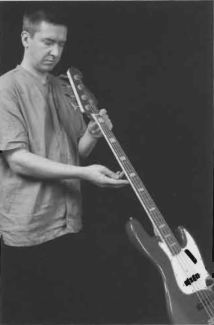
The steps for the set-up process if it is DIY is as follows (Ashton 2005, 65-68):
- “[D]ecide your string gauge¨ after some initial experimentation, restringing the chordophone
- “[G]et the¨ chordophone “in tune¨ (refer to 20241209185550-Tuning_a_Bass_Guitar for a specific example)
- Adjust the length of the chodophone nut, “set so it doesn’t hit the first set when played in the open positions¨ but also “doesn’t play out of tune when you fret a note.¨1 See 20241215165631-Composite_Chordophone_Hardware_Components.
- Re-tune your chordphone
- “[C]heck the neck relief,¨ i.e. “the amount of curvature in [the] neck,¨ on the composite chordophone. This can be adjusted “via [a] truss rod,¨ and the three optional outcomes of adjustment are a straight neck, a concave downward bowed neck, and a convex upward curve. Some minimal slight concave bowing is required to let the strings vibrate.2
- ”[A]djust the neck relief¨ of the composite chordophone using the truss rod and a correct truss rod key or Allen wrench. Care must be taken or else the truss rod adjuster or neck may be break. Bolt-on composite chordophones (refer to Bolt-on Composite Chordophone Necks) may require removal of the neck to access the truss rod adjuster.
- Re-tune your chordophone
- “[A]djust bridge height¨ of the chordophone to “ensure that the string doesn’t collide with the fret when playing,¨ using “a twin-pair arrangement¨ or “adjusters on each individual saddle.¨ The target to hit with this is a particular distance “from the bottom of the string to the top of the 12th fret.¨3
- Re-tune your chordophone
- Engage in “intonation adjustment,¨ wherein you use a “tool to adjust the intonation screw that moves the saddle back and forth.¨4
- Adjust the chordophone pickup’s height and lateral movement for “string-to-string balance¨ and good output. The pickup needs to far enough away from the strings “so the string doesn’t make contact during playing and experience a magnetic pull yet close enough to give good output¨ as “[m]oving the pickup too far away can also lose some of the initial instant attack¨ of the pitch.
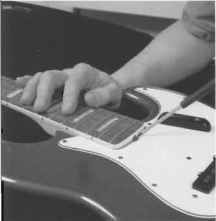
Replacement of Pickups
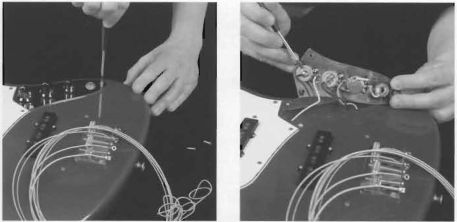
In some cases, it may be necessary to replace the pickup entirely. With screwdrivers, wire strippers, wire cutters, rosin-core solders, and soldering irons immediately available and accessible to you, the following is needed do a successful replacement (Ashton 2005, 69):
- Remove strings from your chordophone, so as to avoid scratching it when removing its current pickup
- “[G]et access to the wires by removing the control plate, pickguard or rear control cavity cover(s) as applicable¨
- “Draw a diagram of the way your bass is wired,¨ paying “particular attention to the wires coming off the existing pickups, noting their colour and where they are attached.¨ It is recommended, also, to acquire “a wiring diagram for your¨ chordophone.
- “[C]arefully de-solder the pickups from where they are currently attached,¨ cleaning “the excess solder off the parts with solder wick.¨
- “[N]ote the old pickups’ orientation in the instrument and then remove them.¨
- “[I]nstall the new pickups where the old ones were¨ ensuring “proper orientation.¨
- “[R]un the new wires back to the controls that the old pickups were attached to,¨ ensuring the wires are “the proper length¨ and “cutting and stripping¨ the wires for careful re-soldering “onto the old connections¨
- “[R]eattach the pickguard and/or control cavity covers, string up the bass, adjust the pickup height,¨ then “test your new pickups.¨ See Set-up, i.e. Action Adjustment for some background on pickup adjustment.
musicology composite_chordophone bass guitar bass_guitar chordophone_nut composite_chordophone chordophone_bridge chordophone_pickups composite_chordophone_frets truss_rod truss_rod_key neck_relief chordophone_action action wire_strippers wire_cutters solder rosin-core_solders wire_cutter wire_stripper strummed_string_instrument_pick_guard plucked_string_instrument_pick_guard composite_chordophone_pick_guard pick_guard pick_guards chordophone_controls chordophone_bridge pitches string_instrument_controls string_instrument_bridge music musicology
bibliography
- Morrish, John, ed. “Strings & Maintenance.” In The Bass Handbook: A Complete Guide for Mastering the Bass Guitar, 1st ed., 55–70. San Francisco, CA: BackBeat, 2005.
Footnotes
-
Testing for this on a bass guitar involves placing “a finger between the second and third fret, holding the note down,¨ followed by tapping “down on the string at the first fret with […] other hand¨ (Ashton 2005, 66). The result observed should be “a gap evident between the bottom of the string and the first fret, or an audible click¨ (Ibid). ↩
-
To test for this on a bass guitar, “hold down the first fret–or place your capo across the first fret position–at the E-string and then hold down the last fret simultaneously,¨ perhaps even using your elbow, then tapping “down between the seventh and ninth frets […] to see if you can hear an audible click¨ (Ibid). “[A] small amount of relief¨ should be evident in this test. ↩
-
Make sure to research appropriate distances to achieve for this sort of adjustment, accounting for previous changes in other steps (Ashton 2005, 67). ↩
-
An appropriate test here is to “play the open string and compare it to the fretted note at the 12th fret.¨ The same note should be produced by both. The higher, or the sharper, the fretted note the further away from the neck the saddle needs to be moved. The lower, or flatter, the fretted note the closer to the neck the saddle needs to be moved. ↩