Composite Chordophone Hardware Components
From “Inside the Bass¨ in The Bass Handbook
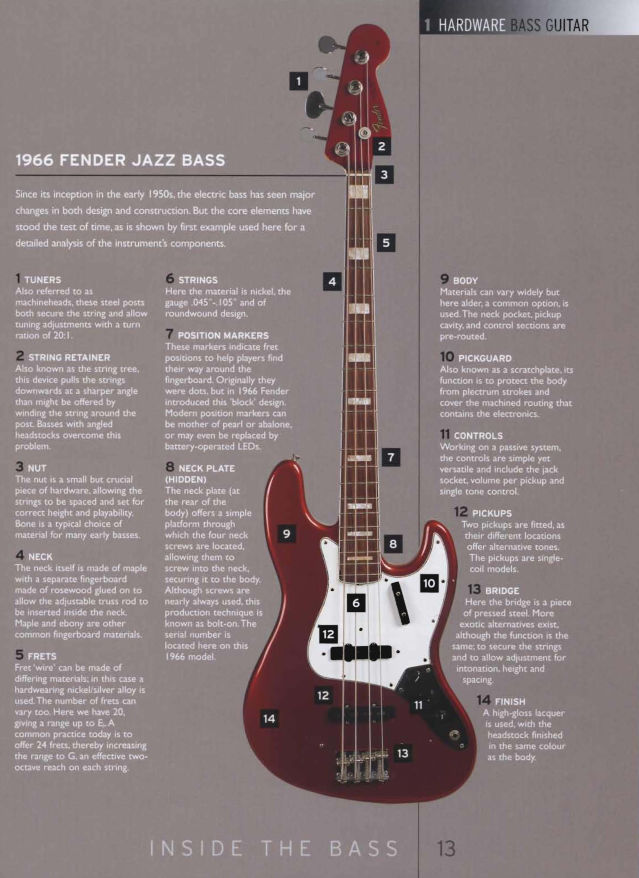
From “Inside the Bass¨ in The Bass Handbook
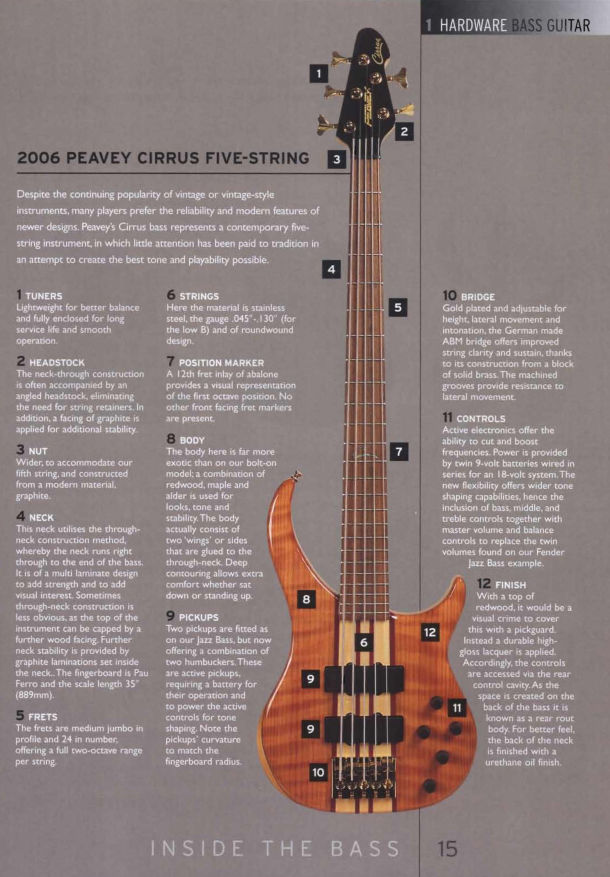
My bass guitar model hitherto
Hitherto my bass guitar model is a Yamaha TRBX305 5-string black rosewood electric one. It’s design is more similar to the 2006 Peavey Cirrus Five-string example above.
Overall, the parts of a composite chordophone at minimum seem to be, from top to bottom (Ashton 2005, 13 & 15):
- Tuner pegs or machineheads, steel posts securing the string and allowing adjustments on the tightness and looseness of the string
- Headstock, which sticks out of the neck of the bass guitar and has the tuners or machine heads on it
- Nut, a protrusion between the headstock and rest of the bass guitar neck, spacing and setting the strings for correct height and playability
- The neck, through which the string run atop, and across and on which perpendicular divisions called frets reside
- Frets a “wire¨ that runs perpendicular to the neck (or sits horizontally when the neck is upright with the body at the bottom) marking and offering the available notes for each string
- Strings, the “mechanical keys¨ of the bass guitar–the stretched and bound material running up the neck towards the headstock that can be played
- Position markers, markers in-between certain frets meant to guide musicians navigating the frets along the neck
- The body, the larger part that flanks what would have otherwise been the neck on each side, offering stability and defining the timbre and look of the bass guitar. The strings of the neck go on further into the body.
- Pickups, the part of the bass guitar that “picks up¨ the manipulations of the strings and applies electronic shaping of the resulting electric signal to shape its tone, through the controls
- Bridge, a pressed metal attached to the body that is the terminus of the strings running along the neck for the body of the bass guitar; they primarily secure the strings, but can affect their intonation (i.e., clarity and sustain)
- Controls, the electronics of the bass guitar that allows control of the shape of the timbre or tone of the signals from the strumming of the strings–usually these are knobs along the side of the pickups and bridge
- Finish, some kind of lacquer or other paint-like or chemical material that is layered onto the surface of the material comprising the body and headstock of the bass guitar
Optional components are a pick guard and a neck plate. The pick guard would be a layer below the necks and towards the top side of the body meant to protect the body from scratches due to strumming or plucking of strings. Meanwhile, the neck plate would exist behind the neck and protruding from above and behind the body to secure the neck further.
chordophone_finish chordophone_pickups chordophone_bridge chordophone_controls chordophone_body chordophone_position_markers position_markers composite_chordophone_frets composite_chordophone_neck chordophone_nut composite_chordophone_headstock chordophone_machineheads plucked_string_instrument_headstock plucked_string_instrument_neck plucked_string_instrument_frets strummed_string_instrument_headstock strummed_string_instrument_neck strummed_string_instrument_frets string_instrument_bridge string_instrument_finish string_instrument_pickups string_instrument_body string_instrument_nut string_instrument_controls string_instrument_position_markers musicology composite_chordophone_pick_guard strummed_string_instrument_pick_guard plucked_string_instrument_pick_guard composite_chordophone_neck_plate strummed_string_instrument_neck_plate plucked_string_instrument_neck_plate bass_guitar tuner_pegs tuners machineheads neck body controls finish pickups frets nut strings string_instrument_machineheads string_instrument_tuners
bibliography
- Morrish, John, ed. “Inside the Bass.” In The Bass Handbook: A Complete Guide for Mastering the Bass Guitar, 1st ed., 11-44. San Francisco, CA: BackBeat, 2005.