Modes and Scales
The (musical) modes are built from the scale degrees (refer to 20240904131349-Scale_Degrees) of any given one (musical) scale (refer to 20240904103821-Musical_Scale_and_Key_Patterns) (Prehn 2019, 01:54-02:00).
Taking the major scale in the key of C (refer to 20240903174948-Being_“In_Key”) as our example:
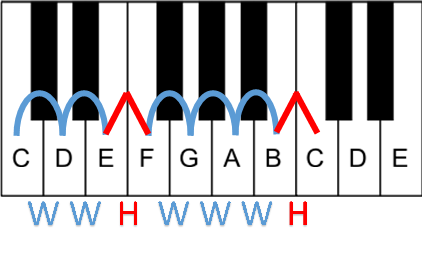
The scale degrees would be thus:
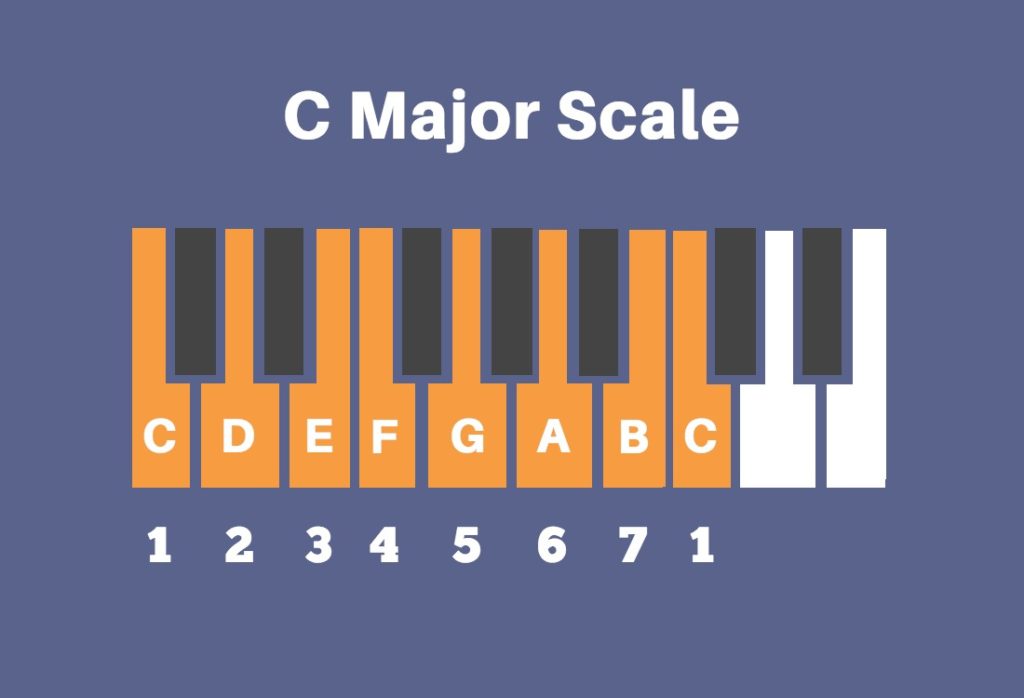
All such (musical) modes can be built using the scale degrees of a (musical) scale, because a (musical) mode simply refers to a (musical) scale that bares some association or relationship to or with other (musical) scales (Prehn 2019, 02:04-02:11). The C Major scale is part of the first family of scales called Family 1 or the major modes (Prehn 2019, 02:11-02:20).
It is not enough to simply play the remaining C major scale starting from one of its degrees in order to build a (musical) mode, although it is a start. If done this way, the resulting mode would fail to be a (musical) scale that is part of the first family of (musical) scales or fail to be one of the major modes. This is because ==what makes (musical) scales modes of each other, and hence part of a family, is more specifically that their half-step / whole step pattern, that occurs in the span of an octave (refer to 20240901153645-Musical_Octaves), sequentially map onto some portion of the theoretically infinitely repeating half-step / whole step pattern sequence of those other scales==. That is, if different scales find themselves sequentially embedded in each other’s repeating constitutive half-step / whole step patterns, they are modes of each other and belong to the same family (Prehn 2019, 03:19-03:53).
Consequently, the (musical) scale being built by starting from a scale degree of a given (musical) scale must fill in the remaining notes by continuing from the missing portion of the half-step and whole step pattern that constituted our original scale.
For example, if starting with the third scale degree on the C Major scale of the standard Western classical piano keyboard , E, our original pattern:
Namely, W-W-H-W-W-W(-H), becomes H-W-W-W(-H), which is truncated. The remaining notes would then be the omitted intervals W-W-, which then become -W-W in H-W-W-W-H-W(-W). An interval pattern H-W-W-W-H-W(-W) in a mode starting with the third degree of the C major scale is part of the family of the major modes and is specifically called the Phrygian scale (Prehn 2019, 04:07). Since we tend to use the major scale as our point of reference for the major modes, the Phrygian scale is more often simply going to be referred to as the Phrygian mode (of the major scale). Things work similarly for the point of reference of other families of modes.
For a scale to be a mode of another scale or set of scales, two features then are required:
- As a (musical) scale, it must start at an in-tune (mechanical) key and its associated pitch that is a scale degree of the other (musical) scale(s)
- As a (musical) scale, its half-step / whole step pattern within an octave must sequentially map onto some portion of an indefinite sequential repetition of the half-step / whole step pattern(s) of the other (musical) scale(s) Another way of saying the second point is that, as a (musical) scale, its half-step / whole step pattern must be sequentially embedded in the unbroken cycle(s) of the sequence(s) of the other (musical) scale(s).
Diverging but correlated (musical) key for modes
Despite two or more scales existing in the same family of modes, they can still all be comprised of some differing in-tune (mechanical) keys or their corresponding pitches. This is primarily due to parts of the half-step / whole step pattern being swapped at the end or beginning of the different modes together with each mode starting at different scale degrees relative to each other. At the same time, the (musical) key that the reference point scale of a family of modes is in affects the (musical) key of all other modes.
Below is a chart of all the known or conventional families and their modes, where represents a whole step and represents a half-step:
semitone whole_tone whole-tone interval intervals phrygian_scale phrygian_mode major_scale major_modes musical_mode musical_modes musical_scale whole_step whole-step musical_family music_theory scale_degree scale_degrees C_major_scale musical_key keys scales consonance mode
bibliography
- Prehn, Oliver. ALL ABOUT MUSICAL SCALES - A COMPLETE GUIDE!!! MP4. NewJazz, 2019. https://youtu.be/Vq2xt2D3e3E.