What are Relative Scales
From “Relative Keys¨ in Music Theory for Electronic Music Producers
In other words, they are the converse of what parallel keys are (refer to 20241026184357-What_are_Parallel_Keys). Whereas parallel keys are musical keys that have the same tonic or root key, pitch or note, relative scales are musical scales that have differing tonics or root keys, root pitches, or root notes but the same set of musical notes or same set of in-tune (mechanical) keys and their pitches.
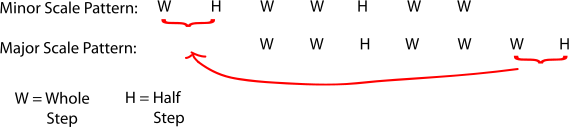
We notice that the major scale and minor scale can potentially be relative scales depending on what differing musical keys they are in, as (Allen 2018, 121):
From “Relative Keys¨ in Music Theory for Electronic Music Producers
[…] the pattern of half-steps and whole-steps is actually the same between the major and the minor, they just start at different places.
Finding the relative scale of a given musical scale involves simply going up to the 6th of that scale in whatever key it is in, and then cyclically continuing the interval pattern for that musical scale from there (refer to 20240901171406-Musical_Intervals & 20240904103821-Musical_Scale_and_Key_Patterns). As an example:
From “Relative Keys¨ in Music Theory for Electronic Music Producers
[…] in C major, the sixth is A. That means that A minor is the relative to C Major.
It would seem that the concept of relative scales relates to or elucidates the concept of musical modes as explored in 20241014155552-Modes_and_Scales.
musical_scale music_theory musical_key major_scale minor_scale relative_scale C_major_scale A_minor_scale intervals scale_quality musical_scale_quality musical_mode musical_modes mode relative_scale
bibliography
- “Relative Keys.” In Music Theory for Electronic Music Producers: The Producer’s Guide to Harmony, Chord Progressions, and Song Structure in the MIDI Grid., 1st ed., 121. Minneapolis, MN: Slam Academy, 2018.