Harmonic Minor Scale
From “Minor Scale Variations” in Music Theory for Electronic Music Producers
[…] over the years composers and producers have started to modify the minor scale in such a way that makes for a major V chord. We do that by simply raising the 7th scale degree. We call this version of the minor scale the Harmonic Minor Scale.
The minor scale that is herein said to have started to be modified is likely the A minor scale, which looks the following way on a Western standard classical piano keyboard (Allen 2018, 133):
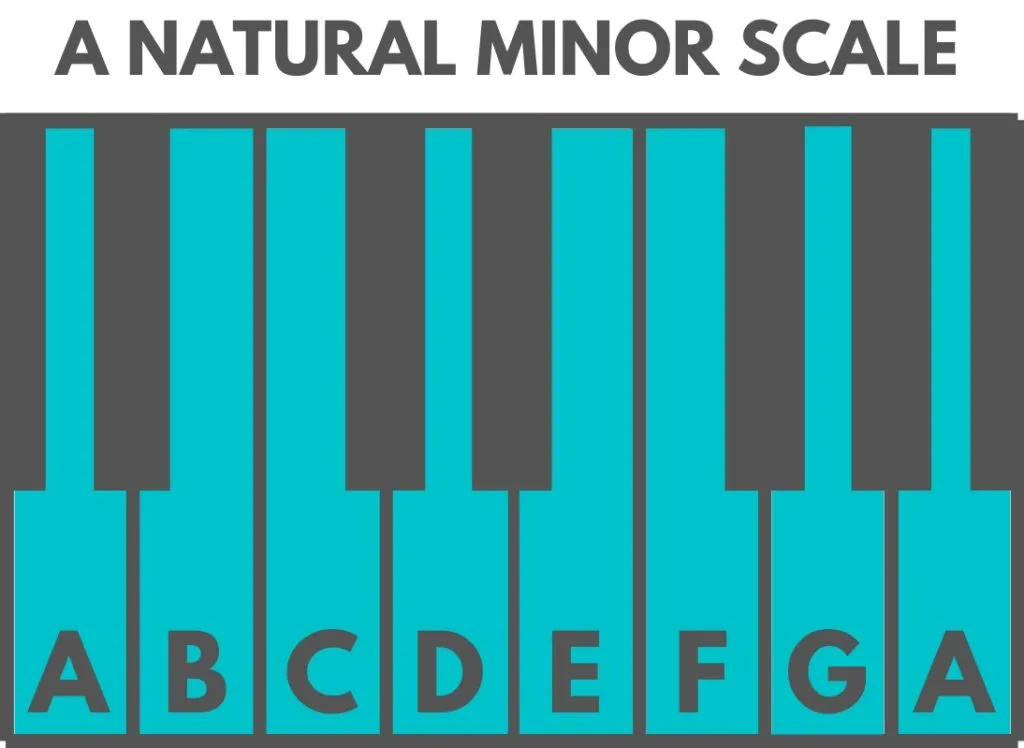
The modification makes for a “major V chord” (or simply, “V chord” as a capitalized roman numeral already means the chord is major), and a major chord is a chord that–typically from lowest to highest pitch, left to right, or up to down–is a triad whose initial interval is semitones and last interval is semitones (or multiples of these) in a given scale (by default the chromatic scale is assumed, i.e. all the white keys and black keys) (refer to Chromatic Interval Variability of Diatonic Chords and 20240928130915-Two_Thirds_in_Triads) (Ibid). ”V” is a numeral for the number , which here describes the consequent chord’s root key as being the fifth degree of the scale.
But recall again, this V chord is the result of altering the A minor scale by “simply raising the 7th scale degree” (Ibid). The 7th scale degree of the A natural minor scale raised results in a G♯ instead of the F it otherwise was (refer to 20240831200842-Musical_Accidentals).
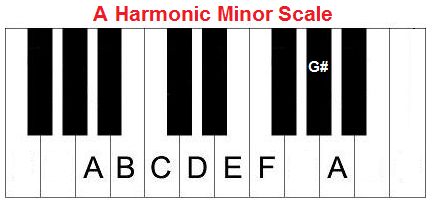
Noticeably, this scale is unusual in that it does not fully involve only alternations between whole tones and semitones, though the interval patterns can still be measured in these terms, drawing from the chromatic scale (Ibid):
From “Minor Scale Variations” in Music Theory for Electronic Music Producers
One thing you might notice about this scale is that it breaks the rule we’ve had about our scales up until now: that they are alternations of half-steps and whole-steps. This scale has a gap bigger than a whole step in it, between the 6th and 7th scale degree. By raising the 7th scale degree, we’ve created a gap of a minor third – […]
The diatonic chord progression consequently also shifts, that is there is also a change in three different chords from their original interval quality (Ibid). After all, each note of the scale is a note shared by three different chords, even if only one of those chords has it as a root key. Counting the minimum chromatic semitones or whole tones as necessary to create triads at each scale degree while staying within the A harmonic minor scale, it is clear that “the third chord, the fifth chord, and,” needless to be said, ”the seventh chord” have had their intervals and interval quality affected (Allen 2018, 133-134):
From “Minor Scale Variations” in Music Theory for Electronic Musicians
The three new chords include one chord we’ve never seen before: an augmented chord (notated with a plus symbol.)
Minor m - ° - M - m - m - M - M - m Harmonic Minor m - ° - + - m - M - M - ° - m
chromatic_scale major_interval minor_interval major_triad minor_triad major_chord minor_chord minor_third major_third A_minor_scale A_natural_minor_scale A_harmonic_minor_scale A_natural_harmonic_minor_scale minor_scale harmonic_minor_scale music_theory diatonic_chord_progression diatonic_chord_progression_pattern musical_note musical_chord musical_scale scale_degree chord_root chord_quality chord_progression augmented_chord augmented_triad
bibliography
- “Minor Scale Variations.” In Music Theory for Electronic Music Producers: The Producer’s Guide to Harmony, Chord Progressions, and Song Structure in the MIDI Grid., 1st ed., 130. Minneapolis, MN: Slam Academy, 2018.