Roman Numeral Chord Notation
From “Roman Numerals¨ in Music Theory for Electronic Music Producers
Roman numerals can be used to convey chords (refer to 20240924121346-What_Chords_Are) in relation to the tonic (refer to 20240904145213-Supertonic_Scale_Degree & 20240924124009-Chords_from_Scales), or first scale degree of the given musical scale (refer to 20240904103821-Musical_Scale_and_Key_Patterns & 20240904103821-Musical_Scale_and_Key_Patterns). The below are the scale degrees of a major scale in the key of C.
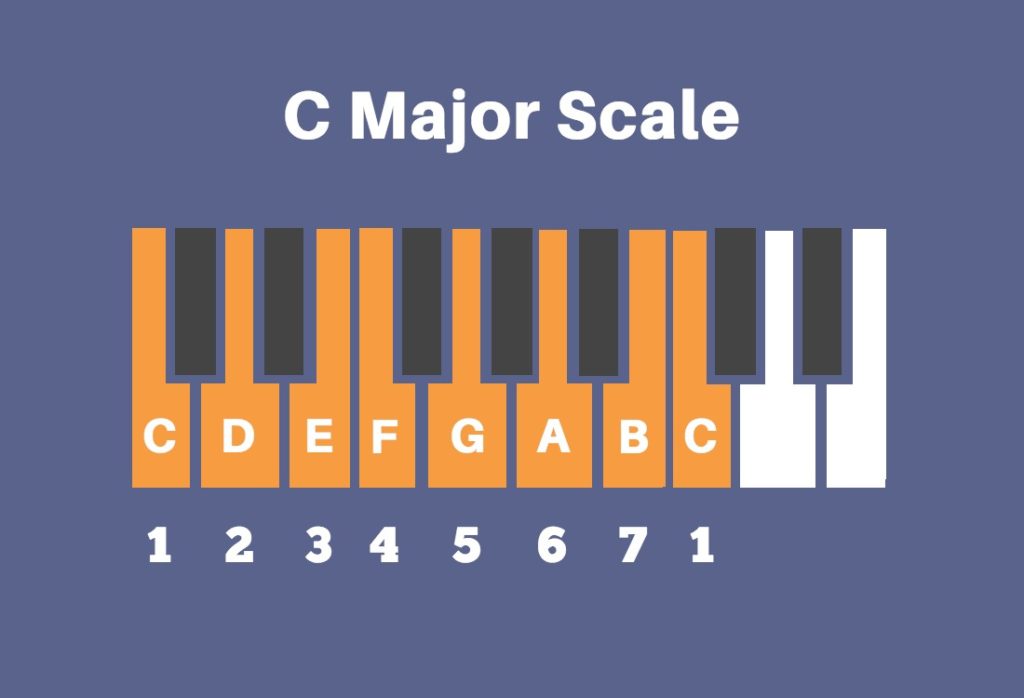
The roman numeral notation way of conveying chords can allow the construction of chord progressions that are agnostic to what musical key (what [mechanical] key / pitch / note in a given scale) one is working in (refer to 20240903174948-Being_“In_Key”). A progression can then be implemented in one scale, or in any key in a scale, or another.
From “Roman Numerals¨ in Music Theory for Electronic Music Producers
[…] roman numeral system has one element that makes it invaluable to us when looking at chord relationships: transposition. […] we can talk about chords without talking about a key.
That being said, roman numeral notation for chords abides by certain rules (Allen 2018, 108):
- The name of the chord in roman numerals is the distance of a chord’s root key from the first scale degree (i.e., the scale’s root key or it’s tonic)
- Capitalization or lack thereof, together with a degree symbol subscript or lack thereof, of a roman number indicates its chord quality or interval quality; lower-cased roman numbers without a degree symbol superscript are minor quality, lower-cased roman numbers with a degree symbol superscript are diminished quality, and, finally, upper-cased roman numbers without a degree symbol superscript are major quality.
- For chords beyond a triad, a decimal arabic number (e.g., sequence of arabic numerals) must follow the roman number to indicate that an interval has been inserted/added to what otherwise would have been a triad (refer to 20241015192834-Injecting_Intervals_into_Chords).
- The chord notated this way should be assumed to be in some sort of key unless otherwise indicated.
Using this way of notating chords, we can rewrite our diatonic chord progression for triads (refer to 20240927133630-What_is_a_Diatonic_Chord_Progression) (Allen 2018, 109):
From “Using Roman Numerals¨ in Music Theory for Electronic Music Producers
Remember that our pattern of the diatonic chord progression was this:
M - m - m - M - M - m - dim - M
Our pattern looks like this now:
I - ii - iii - IV - V - vi - vii° - I
roman_numerals conventionalism scale_degree musical_scale chord_progression diatonic_chord_progression root_key arabic_numerals keys musical_key major_triad minor_triad diminished_triad major_chord minor_chord diminished_chord music_theory
bibliography
- “Roman Numerals.” In Music Theory for Electronic Music Producers: The Producer’s Guide to Harmony, Chord Progressions, and Song Structure in the MIDI Grid., 1st ed., 107. Minneapolis, MN: Slam Academy, 2018.
- “Roman Numeral Notation.” In Music Theory for Electronic Music Producers: The Producer’s Guide to Harmony, Chord Progressions, and Song Structure in the MIDI Grid., 1st ed., 108. Minneapolis, MN: Slam Academy, 2018.
- “Using Roman Numerals.” In Music Theory for Electronic Music Producers: The Producer’s Guide to Harmony, Chord Progressions, and Song Structure in the MIDI Grid., 1st ed., 109. Minneapolis, MN: Slam Academy, 2018.