Ambient Light in Visual Art
From “Lighting Fundamentals¨ in Light for Visual Artists
[…] when light travels through the atmosphere of the earth, the shorter wavelengths of light become scattered. The earth’s atmosphere is composed of various gases, and these gases scatter light when the electrons within them interact with light. Photons traveling through the atmosphere encounter the electrons, which can absorb and re-emit them and point them in a different direction, causing a diffuse scattering effect. Shorter wavelengths are more likely than longer ones to be diffused […].
What determines the ambient light in a space, scientifically speaking, is then the (Yot 2020, 12):
- The gases present in a given space
- The gas density over a given travel distance
- The wavelengths of the emitted light from the source
These factors influence the average wavelength of the light that reaches the optical organ or device (e.g., a person’s eye or a camera). The gases serve as a filter, and generally the filter affects shorter wavelengths first before longer wavelengths.
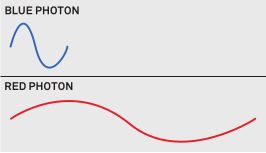
But, what wavelengths there are within that range will determine the final color of light that reaches us. The density of the gas over that distance affects how effective that filter is (Ibid):
From “Lighting Fundamentals¨ in Light for Visual Art
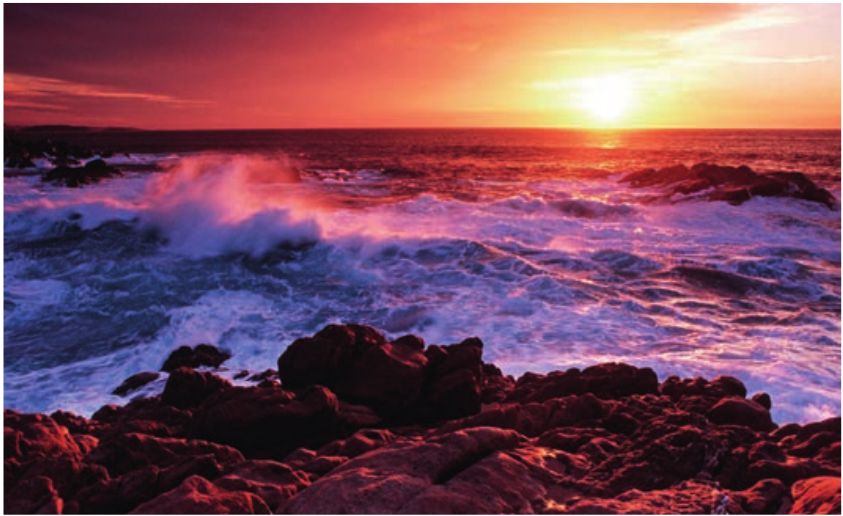
Longer wavelengths of light, such as red, can travel further through the atmosphere without being scattered. This is why sunsets are red: as the sunlight travels through a thicker layer of air to reach us when it is lower in the sky, a lot of the blue light is lost from scattering, and the light that remains is predominantly red.
This is because, the less of a gas a given specific wavelength of light has to travel through for a given distance, the less progressive scattering can occur to it along or across that distance, or the more slowly scattering happens for it along that distance.
visual_art art spectroscopy spectrum_of_light electromagnetic_spectrum electro-magnetic_spectrum electromagnetic_radiation electro-magnetic_radiation spectroscopy hue color ambient_light skylight sunlight optics color_theory atmospheric_gas atmospheric_gases
bibliography
- “Lighting Fundamentals.” In Light for Visual Artists: Understanding and Using Light in Art & Design, 2nd ed., 9–116. London, UK: Laurence King Publishing, 2020.