Correlations Between Light and Shadow in Visual Art
From “Lighting Fundamentals¨ in Lighting for Visual Artists
By smaller is meant the size of the object on the two-dimensional plane, rather than the relative size of the object in a three-dimensional space having accounted for perspective or vantage point. For example, the sun is many times larger than Earth, but in the sky it would appear to be the smallest object. It is this that matters in visual art.
Given the size of the light source on the plane within the field of view or line of sight, a visual artist can say that the shadow or shadows it will cast will be starker, harsher, sharper or harder against a given surface. This is especially so if the source of light is emanating white light, because it determines how much light is reflected around the cast shadow and thereby the local or intrinsic tonal value of the pigments around it.
So, an image typically presupposes some source of light, called a light source, if it is to be visible at all for depiction or rendering, as it provides contrast and allows pigments to have hue.
Inversely, the bigger the light source the softer the shadows (Yot 2020, 11):
From “Lighting Fundamentals¨ in Lighting for Visual Artists
The second source [of light], the blue sky, is a very large light source and, as a result, creates very soft shadows (which are completely masked by the direct light coming from the sun).
It is important to keep in mind that an on average blue light coming from all directions will not only be softer, but will make more visible pigments reflective of blue light than pigments that absorb blue light. When no other light source than this is involved, the result is a monochromatic tonal value gradient of blue hue. Consequently (Ibid):
From “Lighting Fundamentals¨ in Lighting for Visual Artists
The light coming from the sky has a very strong colour[sic] cast, which affects everything in this scene [of a white ball atop a white surface]. The shadow cast by the ball is blue because it is illuminated by blue skylight, since the ball is shielding it from the white light of the sun.
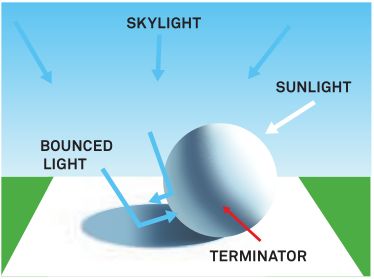
The name for light that is reflected around and bounced off the atmosphere is called skylight. Meanwhile, we can call this light, insofar as it also comprises or biases the local or intrinsic tonal value towards a certain hue by its omnipresence relative to the relevant surfaces and objects, ambient light. Ambient light comes from all directions in a given space. The light source that is the sun in our example would be considered directional light.
In addition, this ambient light interacts with directional light on interacting hue-pigmented surfaces, as exemplified in our scenario of a white ball on a white surface (Ibid):
From “Lighting Fundamentals¨ in Lighting for Visual Artists
[…], the light that is reflected between the [white] card [below the ball] and the ball is also predominantly blue (even though the card and ball are white), since it is blue skylight that is being reflected by the white objects.
More accurately, the ball and surface are predominantly reflecting white light from the sun, save for the cast shadows of that light source as they are opportune for the influence of the blue ambient light instead. However, the blue skylight increases the presence of blue light relative to the other light within the white light (white light contains all basic colors of light) in the environment, and thus the light reflected off the surface or ball “budgets¨ more of its reflectivity for the blue light than other light colors. Which both can easily budget out for this blue light because both the ball and the surface it sits on can already reflect all light, as they have “white¨ pigment.
Consequently, the interaction between ambient and directional light on a surface is contingent on the pigmentation off that surface, as that determines its “budgetary¨ constraints for the colors of light that can reflect off it.
Finally, the distance and angle between surfaces determines the amount of reflections, thus the brightness, of a given light; hence (Ibid):
From “Lighting Fundamentals¨ in Lighting for Visual Artists
[…] surfaces that are closer together receive more of […] reflected light than those that are farther apart; the bottom part of the ball is lighter than the centre[sic] because it is closer to the white card.
Cast shadows and directional shadows themselves work along a tonal value gradient due to the fact that (Ibid):
- Surfaces facing away from directional light source, while creating a cast shadow that appears as a deformation of its shape, may have that cast shadow extend far enough on a surface that the portion of the surface it has extended to is lit up again by that directional light, to varying degrees due to reflection of that light from surrounding objects’ surfaces and due to reception of ambient light.
- The tonal value gradient of the directional shadow of a given surface is determined by the greater reflectivity of angular surface contact or intersection the closer those surfaces are, i.e. the closer to their meeting spot one gets, relative to the light made available to those surfaces for reflection. Typically, the result is that bounced light increases the closer the contact between the surfaces, and insofar as this light “fills in¨ the shadow of a surface it is known as fill light. Hence, the darkest part of the directional shadow ends up being a surface area on the surface or the object between the part of the object’s surface facing a light source and the part of the object’s surface facing away from the light source that is nonetheless in close contact with a reflective surface thereby having fill light, and this in-between area is known as the terminator of the directional shadow.
Balance-point shadow v. terminator as darkest shadow
There is also the balance-point shadow, the shadow of direct contact between (parallel) surfaces of two objects neither of which themselves are light sources and one of which is directly receiving light, wherein ambient light is absent and directional light is completely blocked.
visual_art field_of_view line_of_sight pigment light_source ambient_light directional_light terminator directional_shadow cast_shadow balance-point_shadow bounced_light reflected_light electromagnetic_spectrum electro-magnetic_spectrum electromagnetic_radiation electro-magnetic_radiation spectroscopy color_theory tonal_value tonal_values local_tonal_value intrinsic_tonal_value shadow_tonal_value pigmental_tonal_value transitional_tonal_value optics fill_light reflection
bibliography
- “Lighting Fundamentals.” In Light for Visual Artists: Understanding and Using Light in Art & Design, 2nd ed., 9–116. London, UK: Laurence King Publishing, 2020.