Shape of Chord Progressions
From “Root Position¨ in Music Theory for Electronic Music Producers
[…] all the chords we have looked at can be said to be in root position. Simply put: That means the root of the chord is on the bottom. We’ve built the chords using the pattern Root - Third - Fifth, so the root of the chord is the lowest note in the chord. That makes the third always the middle note, and the fifth always the top note.
Typically, chord triads are constructed by selecting a chord root from the key of a scale, starting on the left, or “the top,¨ of the standard Western classical piano or the piano roll editor (see 20240924124009-Chords_from_Scales). This sequence of the selected (mechanical) keys is known as root position, which we have been taking for granted (e.g., in 20240927133630-What_is_a_Diatonic_Chord_Progression & 20240924124009-Chords_from_Scales).
This convention can be broken, however, in cases where it helps:
From “Root Position¨ in Music Theory for Electronic Music Producers
[…] your chord progressions to really flow from one chord to the other […]
The convention is broken by making inversions (Allen 2018, 86).
Triad chords have two possible inversions, and one can speak of them based on which of their (mechanical) keys, pitches or notes are at “the bottom¨ of the piano roll editor or on the right of the standard Western classical piano (Allen 2018, 87):
From “Inversion Types¨ in Music Theory for Electronic Music Producers
The inversion that has the third at the bottom is sometimes called first inversion, and sometimes we use the subscript number 6 to indicate this inversion. […] For the inversion with the fifth in the base we can call it second inversion or use the subscript 6/4.
In sum, there are two inversions (Ibid):
- The first inversion, with what would be classified as a third in root position at the bottom instead
- The second inversion, with what would be classified as a fifth in root position at the bottom instead
See below example, using the C triad in the key of C major scale:
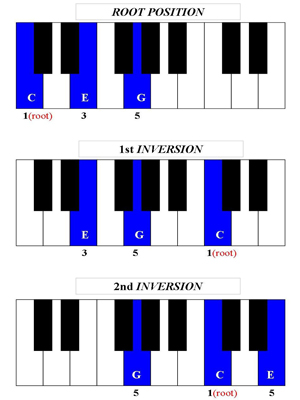
Inversions as Harmony-Preserving Melodic Shifts
piano_roll_editor root_key root_note root_pitch chord_root musical_key musical_scale conventionalism musicology root_position C_major_scale major_scale C_triad C_triad_chord #inversion chord_inversion triad_inversion triad_chord_inversion
bibliography
- “Root Position.” In Music Theory for Electronic Music Producers: The Producer’s Guide to Harmony, Chord Progressions, and Song Structure in the MIDI Grid., 1st ed., 86. Minneapolis, MN: Slam Academy, 2018.
- “Inversion Types.” In Music Theory for Electronic Music Producers: The Producer’s Guide to Harmony, Chord Progressions, and Song Structure in the MIDI Grid., 1st ed., 87. Minneapolis, MN: Slam Academy, 2018.