Two-Finger Composite Chordophone Plucking
From “Tutorial¨ in The Bass Handbook
Players soon realised that by alternating two fingers one could halve the workload on one finger, or… play twice as fast.
That is, on composite chordophones, the labor of one finger can be subdivided into the labor of two fingers, such that one finger is less burdened (Ashton 2005, 135). With practice, this can allow for faster playing by alternating the fingers plucking (Ibid).
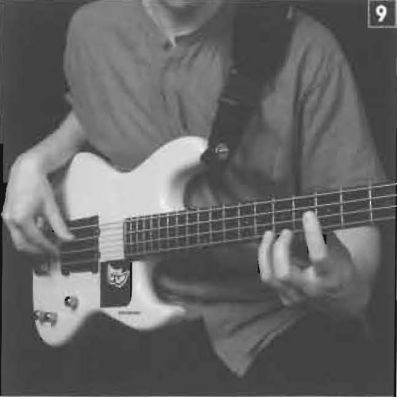
To practice this kind of fingering, one can deaden the strings and do the following (Ashton 2005, 135-136):
Exercise 12 from “Tutorial¨ by The Bass Handbook

Exercise 13 from “Tutorial¨ by The Bass Handbook

Then repeat these without deadening the strings.
When going across strings during practice with two-finger plucking, it is important to avoid raking, or the process of “¨dragging [one’s] finger down across the strings to play the fretted notes¨ (Ashton 2005, 126). This technique is acceptable, but can distract from the point of these exercises, which is to improving two-finger plucking. This is especially true for these exercises in particular:
Exercise 14 from The Bass Handbook

Exercise 15 from “Tutorial¨ by The Bass Handbook

composite_chordophone chordophone string_instrument strummed_string_instrument plucked_string_instrument music musicology two-finger_plucking plucking string chordophone_strings
bibliography
- Morrish, John, ed. “Tutorial.” In The Bass Handbook: A Complete Guide for Mastering the Bass Guitar, 1st ed., 121–238. San Francisco, CA: BackBeat, 2005.