Defining Tonal Values in Visual Art
From “Pencil Values¨ in Drawing for the Absolute and Utter Beginner
Values are shades of gray, on a scale ranging from black to white. They correspond to how dark or light, in any color, anything appears in the world around you. Beginners initially refer to values as “shading” or “shadowing.”
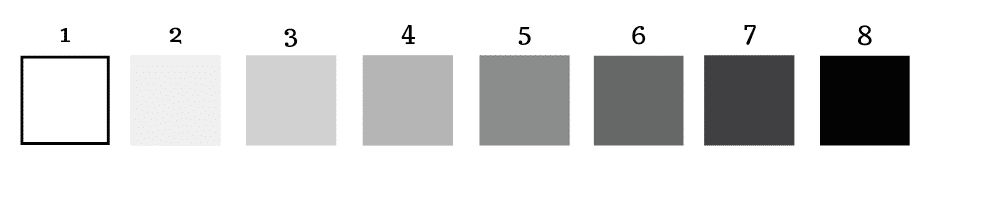
The “shades of gray¨ rather refer to the spectrum or step-wise up-climb and down-climb of light and dark pigments. Light pigments reflect more light, while dark pigments absorb more light.
Non-black hues are always lighter than black
By consequence, color pigments are always lighter than completely dark pigments, because the hue (i.e., the frequency of light) observed in the pigment implies some light was reflected off the pigment.
Nonetheless, each hue can also go from dark to light, since there can be a spectral or step-wise increase or decrease of absorption for a given quantity of light at a given frequency. That is, the hue does not need to change for the amount of reflected light to change, though changing the amount of reflected light may change a hue.
To sum up, value, or more specifically tonal value, refers to the amount of absorption or reflection of light by a pigment such that the pigment looks darker (or, as if it has concentrations of black pigment) or lighter (or, as if it has concentrations of white pigment).
tonal_value electromagnetic_spectrum electromagnetism spectrum_of_light spectroscopy pigmentation black white electromagnetic_radiation electro-magnetic_radiation electro-magnetic_spectrum electro-magnetism art visual_art
bibliography
- Capp, Robbie, ed. “Pencil Values.” In Drawing for the Absolute and Utter Beginner, 55–74. New York: Watson-Guptill Publications, 2003.