Pickup Designs for Chordophones
From “Inside the Bass¨ in The Bass Handbook
Passive pickups employ simple physics to amplify your bass signal. A wire coil wrapped around a magnet generates a current when stimulated by the movement of the string. That signal is sent to the output jack and then to an amplifier to make it audible. […] Active pickups still employ magnets and wire but require powering by either a battery or alternative power source such as phantom power (power is sent back down your cable by the amplification source) or adaptor. Normally a 9-volt or 18-volt battery circuit suffices. By offering a powered signal before it reaches your amplifier, active pickups can be of low-impedance design, allowing more flexible tone-shaping circuitry, extremely low-noise operation, and long cable runs to be used without the signal losses common on passive instruments.
Functional Differences in Pickups
This information can be handily summarized thusly (Ashton 2005, 19):
- Passive pickups are pickups that use the physics of a wire coil around a magnet to generate current when there is movement of the strings in the chordophone or string instrument, which is then sent as a signal to the amplifier.
- Active pickups “still employ magnets¨ but also require powering by either a battery or other power source in order to allow for more complex pre-amplification / pre-speaker signal processing in the form of flexible tone-shaping and noise reduction. It also allows the signal to be low impedance and compensates for signal loss.
| passive pickup | active pickup |
|---|---|
| - Generates a current without needing an additional power source, through the physics of coil & magnet interaction - Has less tone-shaping possibilities - Higher impedance signal - Does not compensate for signal loss | - Requires a separate, independent power source for signal pre-processing - Allows more flexible tone-shaping - Low impedance signal - Compensates for signal loss |
It is important to note that for the power source of active pickups, “a 9-volt or 18-volt battery circuit suffices¨ (Ibid).
My bass guitar model hitherto
My bass guitar, hitherto a Yamaha black rosewood 5-string electric TRBX305, counts as an active bass.
Broad Engineering Differences in Pickups
In addition to pickups being either active or passive, for pickups (Ibid):
From “Inside the Bass¨ in The Bass Handbook
There are three basic designs […]: Precision or P-style, Jazz or J-style, and humbucking. […]
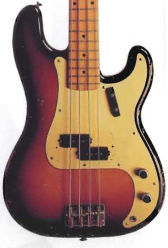
Precision or P-style pickups have a split, whereby, e.g. on a bass guitar, one half is “for the E- and A- strings¨ while the “lower-set half¨ covers “the D- and G- strings,¨ allowing for “a hum-cancelling operation to be performed by using two separate coils wired in a series¨ and using “two smaller magnets¨ (Ashton 2005, 20). See below (Ibid).
From “Inside the Bass¨ in The Bass Handbook
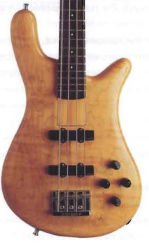
Jazz or J-style pickups, on the other hand, use “a regular single coil with four mounting lugs and […] twin pole pieces per string,¨ requiring a “second pickup¨ for achieving a “hum-cancelling effect¨ (Ibid). See below (Ibid).
From “Inside the Bass¨ in The Bass Handbook
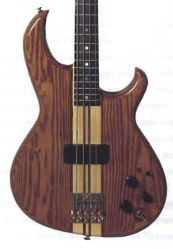
Finally, humbucking pickups (a.k.a., hum-cancelling pickups) usually employs at least “two coils […], each with opposite magnetic polarity¨ yet “wired together to form one unit¨ (Ashtion 2005, 20-21). In theory, these pickups can come in any shape, but they often come in a shape that is often called a soapbar, referring to the fact that “it looks like a bar of soap¨ (Ibid). See below (Ashton 2005, 20).
From “Inside the Bass¨ in The Bass Handbook
My bass guitar model hitherto
My bass guitar model, hitherto a Yamaha black rosewood 5-string electric TRBX305, has a Jazz style pickup, based on its appearance.
The engineering differences affect the sound or tone of the bass guitar, which can be compared thusly (Ashton 2005, 20-21):
| feature | P-style | J-style | Humbucking |
|---|---|---|---|
| tone / timbre | Punchy, deep, growling bottom end; rich highs | Bright, clean notes and smoother blending | Thicker, darker sound; sometimes a mid-range sound |
passive_pickups active_pickups chordophone_pickups string_instrument_pickups bass_guitar electrical_current power_source magnetism electro-magnetism electromagnetism phantom_power circuit musicology
bibliography
- Morrish, John, ed. “Inside the Bass.” In The Bass Handbook: A Complete Guide for Mastering the Bass Guitar, 1st ed., 11-44. San Francisco, CA: BackBeat, 2005.